Product Design Concepts
SP2020_467
Serial Production of Space Components for Megaconstellations
Space Propulsion Conference 2020+1 · 25 January 2021
Nils Hildebrand, Heiko Dartsch, Hans-Peter Harmann
2021
Serial Production
Megaconstellations
Manufacturing
Abstract
AST presents its production line for up to 600 flight units per year using building block technology and design-for-manufacturing principles for megaconstellation programs such as OneWeb.
Space engineering is currently experiencing dynamic development. The market is facing increased demand for small satellites with a high number of identical spacecraft and components optimized for low-cost and serial production. AST Advanced Space Technologies GmbH, a German SME, translates the “New-Space” idea to its own production line capable of producing 600 flight units per year. With a design-for-manufacturing approach and building-block technology, a high grade of scalability and flexibility can be achieved. With this approach, AST produces the fluidic management system for OneWeb, currently one of the world’s largest megaconstellations for broadband internet services.
New companies are entering the market, bringing new technologies and radical price reductions on each product aspect like administration, development, production and test. AST has grown from a start-up to a midsize company and works on innovative technologies to redesign propellant supplies for electrical propulsion, and is world-leading in the production of xenon flow control units. On the product side, AST serves this market with a fluidic assembly technology analogous to the printed circuit board with surface-mounted components in electronics: a flow management system based on building blocks optimized for high volume production at low cost.
1. Price Target
An increasing number of players on the customer and producer side causes a shift in price target determination from an intrinsic to an extrinsic pricing process, in which the market sets a price and formulates a Go/No-Go criterion during design and process development. Production process development is therefore subject to cost optimization in each subprocess to meet the price target.
2. Using Modified Commercial-off-the-Shelf Components (COTS)
Space-grade key components can be purchased in three ways: expensive long-lead items from few specialized producers; developed from scratch with own capabilities; or from ground-application commercial-off-the-shelf products adapted to reach space grade. For most key components, AST uses the third approach, adapting proven industrial or automotive products in co-engineering with suppliers. High quantities of industrial compounds provide a large number of samples for delta qualification and better statistics than the few prototypes typically available in dedicated space developments.
3. Development and Production Cycles
Development in the “New-Space” era is not necessarily cheaper, but takes far less time, achieved at AST through concurrent engineering – a high grade of parallelization of development subprocesses. Each subprocess is rated by a Readiness Level analogous to TRL to identify bottlenecks. In contrast, serial production is performed in pure series with a well-defined predecessor/successor for each process, allowing simplification and reduced supervision while empowering the producing operator.
4. AST’s Production Line
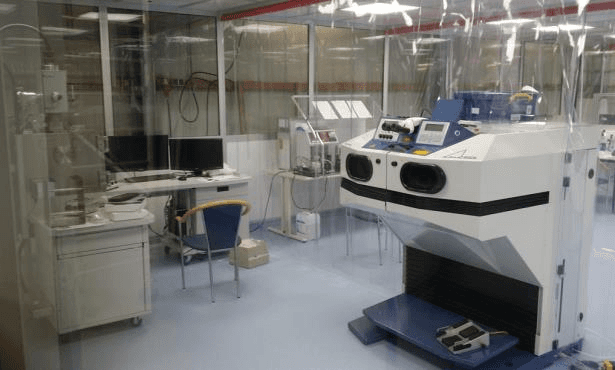
AST’s product line is designed for scalable high quantities, based on a modular system in which highly reliable components are surface mounted by electron-beam welding in one operation – a flow path board (FPB) replacing the printed circuit board (PCB) of electronics. Having most key processes in-house (vertical integration) implies increased development flexibility, scalability and quality control at reduced cost. Units are sequentially cleaned, laser tack welded and EB welded few meters apart with minimal buffer storage to optimize production flow, without leaving the cleanroom.
Currently, serial production for one megaconstellation includes production of units for around 100-1000 satellites per year, entering a tipping point from optimized manual production to partial automation. Optimization of the manual serial process includes creative use of auxiliary tools, short paths, task coordination and reduced lead time, with lot sizes per operator adjusted to individual preferences to ensure motivation. Automation is introduced for either quality assurance (e.g. automated EB and laser welding) or labor cost reduction (e.g. automated acceptance tests with data logging), and both approaches benefit from in-house manufacturing of electronics, mechanical equipment and additive manufacturing.
Conclusion
A manufacturing line for high quantities is a very stable process that can exceed prototype-manufacturing quality even with extensive traditional-space quality-assurance efforts, resulting in products that are both more cost-effective and of higher quality. 110 units of AST’s baseline product are in orbit without failures, accumulating 670,000 in-orbit hours (as of January 2021). New players and concepts are forcing a mindset change in the manufacturing of space components, and industrial concepts including digitalization and automation of terrestrial manufacturing are only beginning to enter the space sector.
Introduction
Introduction
Space engineering is currently experiencing dynamic development. The market is facing increased demand for small satellites with a high number of identical spacecraft and components optimized for low-cost and serial production. AST Advanced Space Technologies GmbH, a German SME, translates the “New-Space” idea to its own production line capable of producing 600 flight units per year. With a design-for-manufacturing approach and building-block technology, a high grade of scalability and flexibility can be achieved. With this approach, AST produces the fluidic management system for OneWeb, currently one of the world’s largest megaconstellations for broadband internet services.
New companies are entering the market, bringing new technologies and radical price reductions on each product aspect like administration, development, production and test. AST has grown from a start-up to a midsize company and works on innovative technologies to redesign propellant supplies for electrical propulsion, and is world-leading in the production of xenon flow control units. On the product side, AST serves this market with a fluidic assembly technology analogous to the printed circuit board with surface-mounted components in electronics: a flow management system based on building blocks optimized for high volume production at low cost.
1. Price Target
An increasing number of players on the customer and producer side causes a shift in price target determination from an intrinsic to an extrinsic pricing process, in which the market sets a price and formulates a Go/No-Go criterion during design and process development. Production process development is therefore subject to cost optimization in each subprocess to meet the price target.
2. Using Modified Commercial-off-the-Shelf Components (COTS)
Space-grade key components can be purchased in three ways: expensive long-lead items from few specialized producers; developed from scratch with own capabilities; or from ground-application commercial-off-the-shelf products adapted to reach space grade. For most key components, AST uses the third approach, adapting proven industrial or automotive products in co-engineering with suppliers. High quantities of industrial compounds provide a large number of samples for delta qualification and better statistics than the few prototypes typically available in dedicated space developments.
3. Development and Production Cycles
Development in the “New-Space” era is not necessarily cheaper, but takes far less time, achieved at AST through concurrent engineering – a high grade of parallelization of development subprocesses. Each subprocess is rated by a Readiness Level analogous to TRL to identify bottlenecks. In contrast, serial production is performed in pure series with a well-defined predecessor/successor for each process, allowing simplification and reduced supervision while empowering the producing operator.
4. AST’s Production Line
AST’s product line is designed for scalable high quantities, based on a modular system in which highly reliable components are surface mounted by electron-beam welding in one operation – a flow path board (FPB) replacing the printed circuit board (PCB) of electronics. Having most key processes in-house (vertical integration) implies increased development flexibility, scalability and quality control at reduced cost. Units are sequentially cleaned, laser tack welded and EB welded few meters apart with minimal buffer storage to optimize production flow, without leaving the cleanroom.
Currently, serial production for one megaconstellation includes production of units for around 100-1000 satellites per year, entering a tipping point from optimized manual production to partial automation. Optimization of the manual serial process includes creative use of auxiliary tools, short paths, task coordination and reduced lead time, with lot sizes per operator adjusted to individual preferences to ensure motivation. Automation is introduced for either quality assurance (e.g. automated EB and laser welding) or labor cost reduction (e.g. automated acceptance tests with data logging), and both approaches benefit from in-house manufacturing of electronics, mechanical equipment and additive manufacturing.
Conclusion
A manufacturing line for high quantities is a very stable process that can exceed prototype-manufacturing quality even with extensive traditional-space quality-assurance efforts, resulting in products that are both more cost-effective and of higher quality. 110 units of AST’s baseline product are in orbit without failures, accumulating 670,000 in-orbit hours (as of January 2021). New players and concepts are forcing a mindset change in the manufacturing of space components, and industrial concepts including digitalization and automation of terrestrial manufacturing are only beginning to enter the space sector.
Paper No.
SP2020_467
Published
2021
Conference
Space Propulsion Conference 2020+1 · 25 January 2021
Authors
Nils Hildebrand, Heiko Dartsch, Hans-Peter Harmann
Keywords
serial production, New-Space, megaconstellations, space process development, cost reduction, electrical propulsion, fluidic management systems, commercial off-the-shelf