Product Specifications
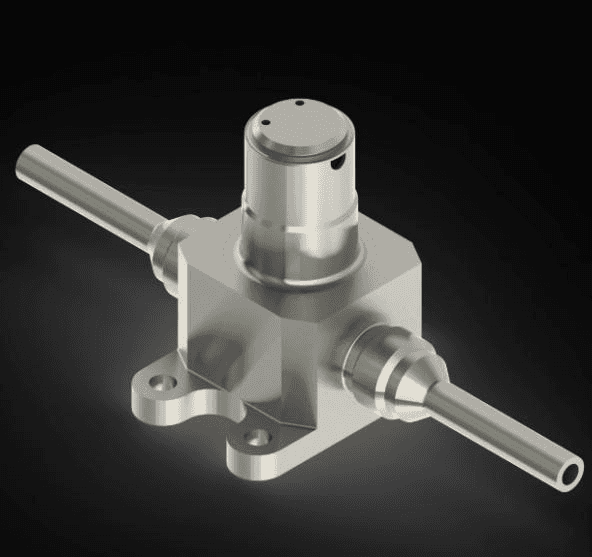
Isolation Valve (IV) - Modular Stand-Alone Isolation Valve for Propulsion Systems
AST Advanced Space Technologies GmbH
2024
Isolation Valve
Electric Propulsion
Space Components
Abstract
AST's Isolation Valve offers high-reliability solenoid isolation with over 1,300 units in orbit, available in single and dual configurations for electric and chemical propulsion systems.
Product Overview
Since 2015, AST has been using high-pressure isolation valves in its electronic pressure regulators and flow controllers. These are direct and very fast-acting solenoid valves with excellent leakage performance over a very high number of operational cycles, produced fully industrialized and ready for high-cadence space production. Over 1,300 valves operating in orbit prove the technology’s high reliability for demanding operations and environments.
In stand-alone configuration, the valves can provide an isolation function embedded in larger fluidic assemblies. Using AST’s Building-Block-Concept with space-qualified and proven components, a large variety of configurations can be offered, with selectable pressure ranges, valve orifices and fluidic interfaces. Solenoid and manual valves are offered as standard valve functions, integrated as single-valve or dual-valve configuration; especially the dual-valve configuration, in either serial or parallel redundancy, offers a highly compact product with minimum integration interfaces at spacecraft level.
Key Features
High reliability, with millions of accumulated hours in space proving robustness and dependability. High performance: very fast-acting, frictionless and leak-tight even after millions of operational cycles. Industrialized for space, with continuous production ensuring consistent performance and short lead times. Designed for flexibility, with a broad range of configurations and standard interfaces customizable to mission needs. Ready for integration, delivered without the need for additional bracketry, saving time and reducing complexity. Fast availability: standard configurations available from stock in small quantities, custom configurations deliverable in 8–12 weeks, with larger quantities available on request.
Characteristics
Three valve variants are offered: ASV-IV-HP1, ASV-IV-HP2 and ASV-IV-LP. All operate with Xe, Kr, Ar, N2 and He, qualified for Xe at 186 bar and Kr at 186/310 bar depending on generation. Maximum sustained inlet pressure (MEP) is 320 bar for all variants; inlet pressure MEOP is 186/310 bar for ASV-IV-HP1, 150 bar for ASV-IV-HP2, and 25 bar for ASV-IV-LP. Selectable flow diameters are 0.4 mm (HP1), 0.4/0.6 mm (HP2) and 0.4/0.6/1.0 mm (LP). Pressure drop ranges from 0.1-10 mbar up to 480 sccm at 310 bar N2 inlet pressure (medium, density and temperature dependent). Operational cycles qualified range from over 100,000 (HP1, up to 310 bar) to over 3,000,000 (HP2, up to 150 bar) to over 50,000,000 (LP, up to 10 bar), with more than 1,000,000,000 valve cycles demonstrated with mechanical integrity at 0.4 mm flow diameter.
Response time is under 10 ms for all variants (opening may be faster depending on medium and inlet pressure; closing time depends on quenching circuit design). Proof pressure exceeds 1.5× MEP (tested value > 465 bar) and burst pressure exceeds 2.5× MEP (qualified value > 775 bar). Internal leakage is below 1×10⁻⁵ sccs GHe and external leakage below 1×10⁻⁶ sccs GHe, both verified during acceptance tests. Filtration rate is 98% at under 11 µm (5µm mesh at inlet and outlet). Fluidic interfaces (¼” tube, AN screwed, or ¼” VCR) can be selected. Mass is under 230 g for single-valve and under 400 g for dual-valve configurations, depending on configuration. Coil resistance is approximately 50 Ω (±3 Ω) at 20°C, with an operating voltage of 28 V (±4 V) pull-in and 8-12 Vdc hold using a pull-in/hold scheme recommended for optimized power consumption; peak power consumption is 24.4 W and hold power 3.4 W.
Thermal range is -10°C to +75°C operational and -20°C to +85°C non-operational. Vibration qualification level is 29.8 gRMS on all three axes, and shock qualification loads exceed 2000 g at frequencies above 1000 Hz. Magnetic moment is below 5 mAm at distances greater than 20 mm, and radiation tolerance is 10 Mrad Total Ionizing Dose (TID).
Interfaces
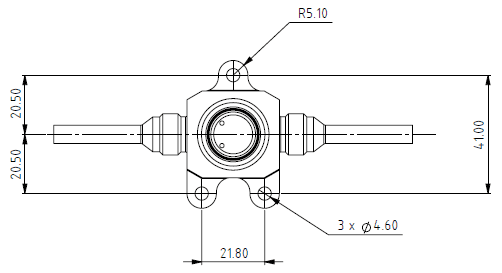
Mechanically, the valves use 3x or 4x M4 through-holes depending on single/dual valve configuration. Electrically, valves are provided as standard with polyimide-isolated flying leads (AWG26). Thermally, they are commonly used with a conductive or insulating washer/spacer, application-dependent.
Acceptance Test Procedure
The standard test sequence comprises: visual inspection of physical properties; HV insulation test; proof pressure test; thermal cycling test; Health Checks #1; optional tests upon request (which can include performance tests for flow parameters such as min/max flow rate and transfer function, at controlled temperature, vibration tests, etc.); optional Health Checks #2; cleanliness and dryness verification; and final inspection. Health Checks include a visual inspection, electrical test, internal leakage test and external leakage test.
Paper No.
Published
2024
Conference
Authors
AST Advanced Space Technologies GmbH
Keywords
isolation valve, solenoid valve, propellant isolation, electric propulsion, chemical propulsion, redundancy, space qualification