Product Specifications
Electric Pressure Regulator (EPR) - Product Datasheet
AST Advanced Space Technologies GmbH
2024
Pressure Regulation
Electric Propulsion
Space Components
Abstract
AST's Electric Pressure Regulator provides stable low-pressure output from variable high-pressure gas storage through two-stage controlled expansion with in-orbit adjustable setpoints and integrated propellant gauging.
Product Overview
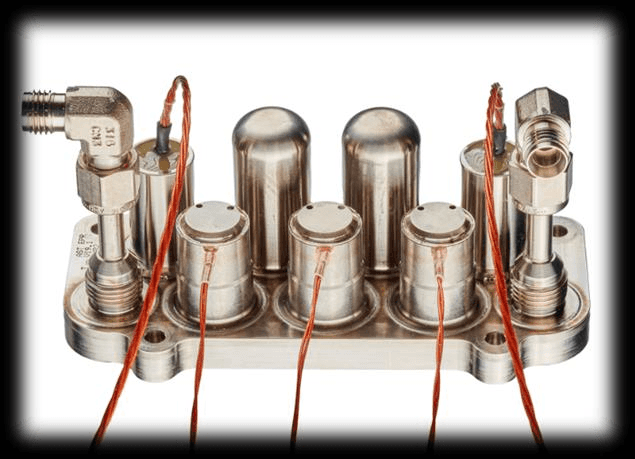
AST’s Electric Pressure Regulator (EPR) reduces variable high storage pressure of inert gases to a stable low pressure. The high pressure at the unit inlet is measured and reduced by controlled expansion in two steps to intermediate and final outlet pressures, with pressure control achieved through on-off switching of high-pressure miniature valves and accurate reading of the downstream pressure. The unit can be controlled to outlet pressures within the measurement range of the integrated low-pressure sensor, and depending on the control electronics design, the setpoint can be varied (e.g. in orbit) to adapt to different mission phases; the high-pressure sensor reading can also be used to perform propellant gauging.
Up to three high-pressure valves can be integrated in the EPR, forming series-redundant barriers to the high-pressure section. Only stainless steel and FKM materials are in contact with the gas, providing good compatibility and a very wide range of applications. The stainless-steel EPR is an all-welded design providing robustness against rupture and propellant loss; all high-pressure joints are made by electron-beam welding, and each unit is proof-pressure and leakage tested before shipment, with inlet and outlet filters protecting the unit during handling and integration.
Customers can request the EPR configured to meet high or low massflow requirements, with outlet pressure ripple performance matched to needs through flow-restricting elements and consideration of downstream ullage. Through its integrated functions, the EPR can simplify the fluidic architecture of a propulsion subsystem, with a typical use-case for distributed thruster configurations, e.g. cold gas or EP thrusters with individual Flow Control Units (FCU). All components of the EPR design are fully qualified with flight heritage, and an extended, modular design concept of the EPR is currently in development.
EPR Characteristics
Operating media: He, N2, Xe, Kr (Xe, N2 with flight heritage). Inlet pressure MEOP up to 300 bar (Xe operation up to 186 bar qualified; N2 operation up to 250 bar; Kr, Ar, He operation up to 300 bar). Inlet pressure EOL 2 bar, depending on required massflow. Proof pressure 1.5× MEOP (design value > 450 bar). Low-pressure line MEOP 1 or 4 bar (depending on LP sensor selection), with low-pressure line proof pressure of 7 bar (limited by LP sensor). Burst pressure > 2.5× MEOP (design value > 750 bar). Massflow rates: > 10 mg/s in fine mode and > 2 g/s in coarse mode, selectable by design and gas-dependent. Outlet pressure ripple < 20 mbar in fine mode, depending on downstream ullage.
Internal leakage < 1×10⁻⁵ sccs GHe and external leakage < 1×10⁻⁸ sccs GHe, both verified during acceptance tests. Thermal range -20°C to +80°C non-operational (including qualification margin) and -10°C to +65°C operational (full performance, gas dependent, heater might be required). Fluid filtration rate 11µm (5µm mesh at inlet and outlet). Mass under 1000 g without harness, varying with configuration. Average power consumption under 10 W, depending on valve actuation frequency. Valve operating voltage 24V to 32V (minimum pull-in voltage required for motorization margin, 50% hold-voltage), with pressure sensor excitation voltage of 10V in sensor voltage excitation mode. Vibration qualification levels exceed 20 gRMS on all three axes, and radiation tolerance is 30 Mrad TID.
Customization Options
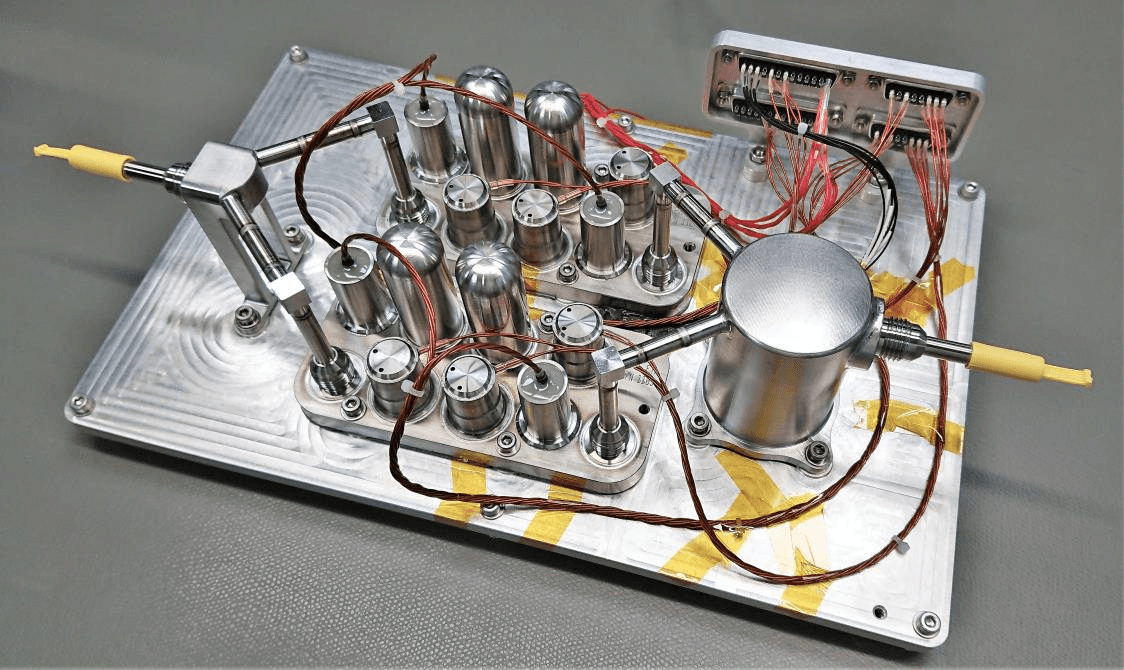
AST’s EPR design allows customer- and mission-specific configuration based on qualified building-block components, with the complete fluidic management integrated into one compact assembly. Past configurations include an EPR with two high-pressure valves for high-flow applications, and a redundant EPR configuration with three high-pressure valves for high-throughput, low-massflow-ripple applications.
Paper No.
Published
2024
Conference
Authors
AST Advanced Space Technologies GmbH
Keywords
electric pressure regulator, pressure regulation, propellant gauging, electric propulsion, flow control unit, redundancy