Product Designs and Development
Cold Gas Thruster Qualification for FORMOSAT 5
34th International Electric Propulsion Conference / 30th ISTS Joint Conference · Kobe, Japan · 2015
Hans-Peter Harmann, Tammo Rombach, Heiko Dartsch
2015
Cold Gas Thruster
Qualification
FORMOSAT 5
Abstract
AST and SpaceTech GmbH qualified four 43 g cold gas thrusters for Taiwan's FORMOSAT 5 satellite, demonstrating 46 mN thrust with an ISP above 69 seconds across one million actuations.
1. Introduction
Four cold gas thrusters control Taiwan’s FORMOSAT 5 satellite, a 525 kg LEO earth-observation satellite developed by NSPO providing panchromatic imaging from a 720 km sun-synchronous orbit, launching on a Falcon 9 in 2016. The lightweight 43-gram thrusters, developed and qualified by AST Advanced Space Technologies GmbH together with SpaceTech GmbH Immenstaad (STI), provide 46 mN thrust at 1.5 bar(a) N2 with an ISP above 69 seconds. Low leakage below 10⁻⁵ mbar l/s limits gas loss during off times, the thruster can be driven from an unregulated bus across a wide voltage range, and has a design allowing easy adaptation to different mechanical interfaces. During the 2014 qualification program the thrusters were tested for the mission requirement of one million actuations; based on a parallel lifetime demonstration test of one billion actuations, the qualification program was extended, with the extended lifetime qualification currently running.
2. Cold Gas Thruster Development
The cold gas thruster (CGT) is based on a miniaturized solenoid valve with low leakage and unique lifetime capability, converted and prequalified for space in AST’s xenon flow control development program (“µFCU”). Development was initiated at the request of SpaceTech GmbH; since the satellite design was already frozen, the thruster had to fit specified geometric and electrical properties, and was carried out in under 2 years including an EM phase, FM production and qualification starting February 2013. The nozzle design was supported by DLR Göttingen using simulation tools to predict flow characteristics and performance, verified by EM tests including thrust measurements on a thrust balance and “thrust-on” delay investigation using a Pitot probe; a 15° cone nozzle with 0.6 mm throat diameter was chosen as best compromise.
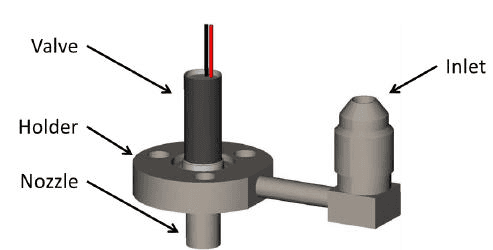
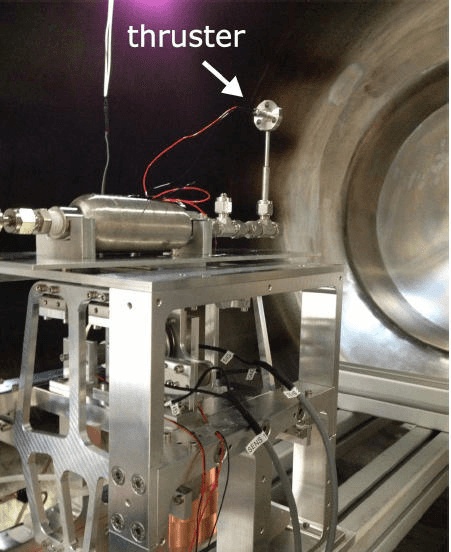
Basic performance characterization used EM thrusters identical to the FMs, mounted on a thrust balance capable of measuring 0.1 mN to 1000 mN at DLR, with repeated firings demonstrating good reproducibility and a derived specific impulse of 70.4 seconds at nominal inlet pressure of 1.5 bar. As nozzle geometry (manufactured reproducibly and precisely) defines thrust and ISP for a given mass flow and temperature, further measurement campaigns monitored only mass flow to determine equivalent thrust level.
3. Operation
The thruster is operated in pull-in/hold mode with a fixed pull-in time of 50 ms; minimum pull-in time is defined as 2.5 ms, and the CGT is designed for a pull-in voltage between 22V and 36V with a hold voltage above 6V to allow supply from an unregulated bus.
4. Manufacturing
A batch of ten thrusters was manufactured for the FORMOSAT 5 project; one was used for production process monitoring, and four flight models, one flight spare and one qualification model were delivered to STI for acceptance and qualification testing, selected from the batch for best matching mass flow (variation between any FM less than 1.3%, against a maximum allowed variation of 5%). The CGTs were fully welded with electron-beam and laser welding, the electrical interface vacuum-potted, and each thruster precision-cleaned and dried before delivery; STI added a diode-clamping circuit to the CGT harness after delivery.
4. Qualification and Acceptance Testing
Since a similar valve had already demonstrated its capabilities within the flow control development program with large margins to the FORMOSAT 5 requirements, acceptance and qualification testing were performed in one shared test, with FMs tested to acceptance level and the QM tested with additional margins, and core parameters verified twice: once at AST’s factory acceptance test and again in STI’s official acceptance and qualification test. The program included function/performance tests (electric parameters, insulation), repeated leakage tests, proof pressure test, thermal balance and thermal cycling (TV), and vibration test; after qualification the QM was sent to AST for a lifetime test of 1.5 million actuation cycles (including 50% qualification margin).
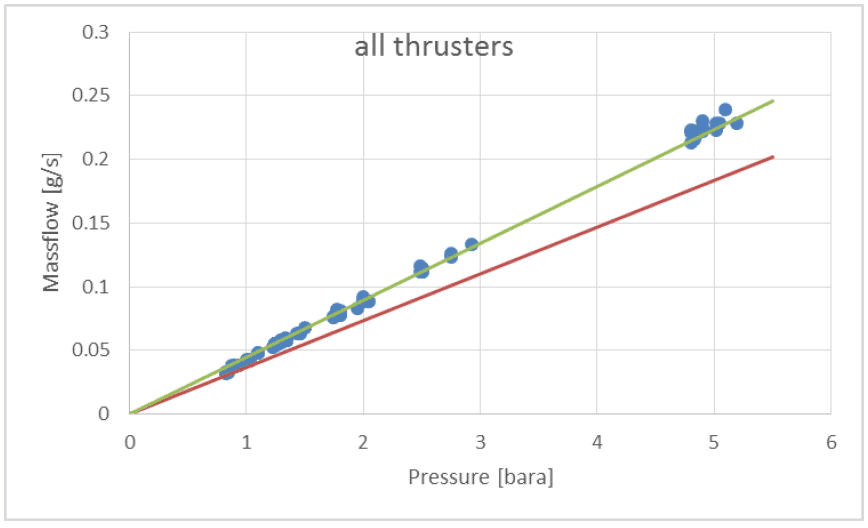
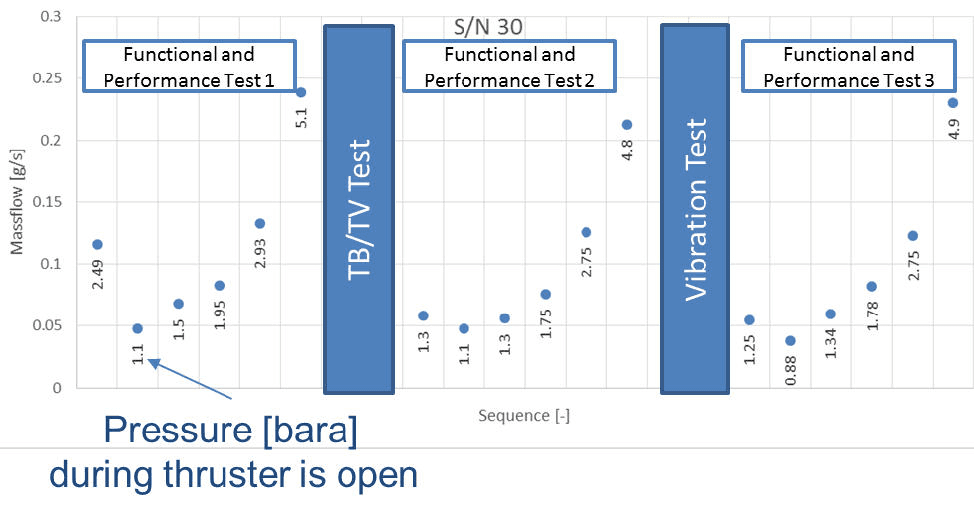
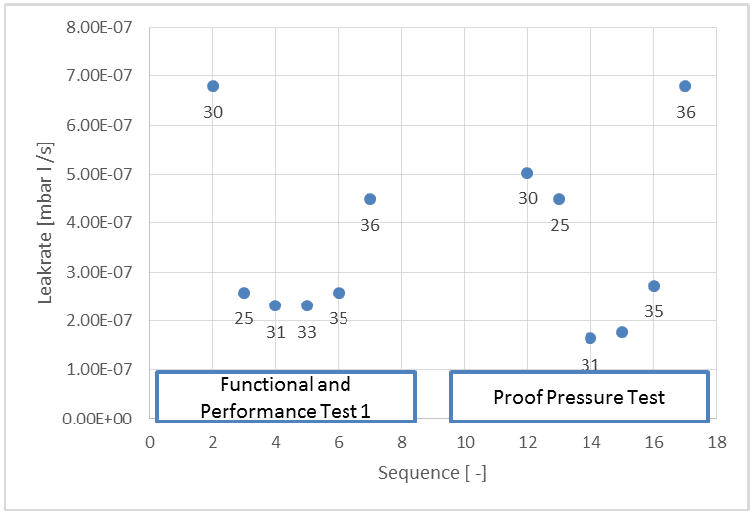
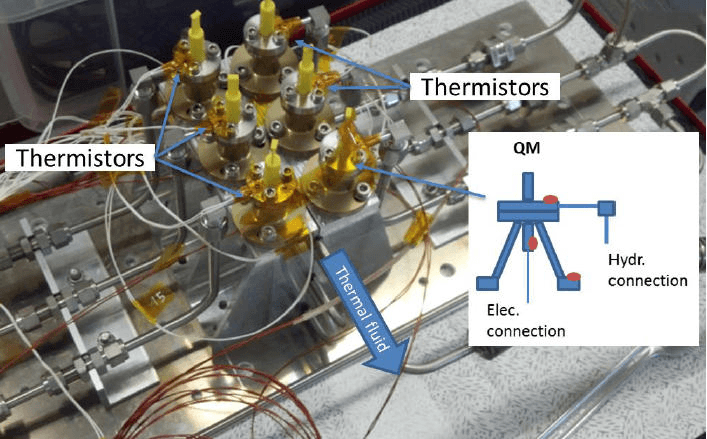
Functional and performance tests showed mass flow varying linearly with inlet pressure across 0.8 to 5 bar (25 to 160 mN equivalent thrust range); switch times, measured electrically via the induced voltage dip as the armature hits its rest, depended slightly on pressure and voltage but stayed unchanged after all stress tests, and mass flow / thrust remained very constant across the full campaign. The leakage requirement of 2×10⁻⁵ mbar l/s was comfortably met, with measured values below 10⁻⁶ mbar l/s and only measurement-uncertainty-level variation across all thrusters. A proof pressure test at 6.5 bar(abs) confirmed unchanged electric parameters, switch time and leakage. Vibration testing at qualification levels (all six thrusters mounted together on a representative support structure) showed no pressure loss or parameter changes, with alignment variation within the 0.2° measurement error. Thermal vacuum testing covered eight temperature cycles under vacuum, with FM acceptance temperatures of -20°C to +50°C (operational) and -30°C to +60°C (non-operational); the QM was operated at the elevated range to cover required test margins, within the -40°C to +80°C viability already shown for the valves during the earlier flow control program.

4.7. Lifetime Test
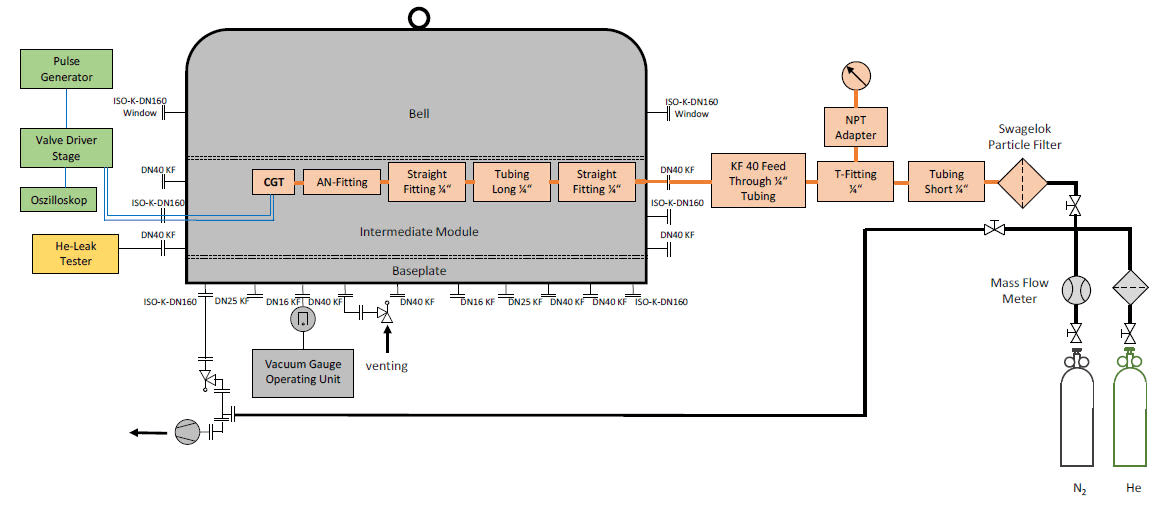
During the former EM test campaign the CGT demonstrated 1.1 billion actuation cycles without failing; FORMOSAT 5 required “only” 1.5 million cycles including 50% margin. The lifetime test was performed in AST’s 50 cm diameter vacuum facility with nominal nitrogen mass flow and nominal pull-in/hold operation, stopping every 50K (later 100K) cycles for leakage, switch time, electric parameter and mass flow tests. For the tested 1.5 million actuation cycles, no variation or drift beyond measurement noise was found; the QM was subsequently put into long-term storage (about one year, not part of the qualification) before reinstallation to continue lifetime testing in an extended qualification.
5. Summary and Conclusion
Five FM thrusters and one QM were successfully tested, with all requirements verified and met. The operation of the AST CGT proved very stable and reproducible; the FMs were delivered and integrated into the FORMOSAT 5 satellite awaiting its expected 2016 launch.
Paper No.
Published
2015
Conference
34th International Electric Propulsion Conference / 30th ISTS Joint Conference · Kobe, Japan · 2015
Authors
Hans-Peter Harmann, Tammo Rombach, Heiko Dartsch
Keywords
cold gas propulsion, FORMOSAT 5, qualification, lifetime test, vibration test, thermal vacuum test