Product Specifications
Cold Gas Thruster (CGT) - LP-CGT and HP-CGT Product Datasheet
AST Advanced Space Technologies GmbH
2024
Cold Gas Thruster
Space Propulsion
Attitude Control
Abstract
AST offers two cold gas thruster configurations: the LP-CGT for regulated systems enabling precise impulse bits and exceptional lifetime, and the HP-CGT for blow-down operation with up to 4 N thrust for detumbling and orbit control applications.
Product Overview
Two Cold Gas Thruster (CGT) designs are available at AST to serve pressure-regulated and unregulated systems onboard spacecraft. In regulated systems, a low-pressure Cold Gas Thruster (LP-CGT) can be operated at constant pressure conditions, providing predictable and repeatable thrust performance; the fast-switching thruster allows very small impulse bits of 110 µNs, and the miniature valve produces very small shocks during actuation, making it well suited for shock-noise sensitive applications. Combined with its exceptional lifetime, this thruster design allows highly accurate satellite attitude control.
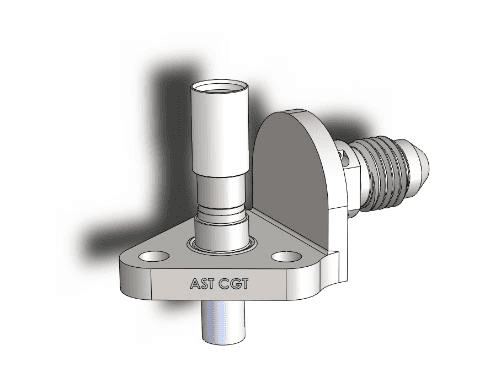
The high-pressure configuration of AST’s Cold Gas Thruster (HP-CGT) accepts operation in blow-down mode when directly connected to the propellant storage tank. Especially at the beginning of mission life this allows for high thrust (up to 4 N), which can be used for spacecraft fast detumbling or even orbit control. Both CGT configurations are composed of an inlet interface, inlet filter, miniature valve, mounting body and thruster nozzle. Depending on operational needs, the CGT can be mounted on heated brackets or equipped with dedicated heating elements to maintain known operational conditions. Only stainless steel and FKM materials are in contact with the gas, providing good gas compatibility across a very wide range of applications.
The CGT design is all-welded, providing robustness against rupture and propellant loss; all high-pressure joints are made by electron-beam welding, and each unit is proof-pressure and leakage tested before shipment, with inlet filters and nozzle dust-caps protecting the unit during handling and integration. The designs are based on AST’s flight-heritage components and manufacturing processes: flight heritage exists with the heritage LP-CGT design for use with Nitrogen, an upgraded LP-CGT design is qualified for operation with Xenon, and the HP-CGT is in development.
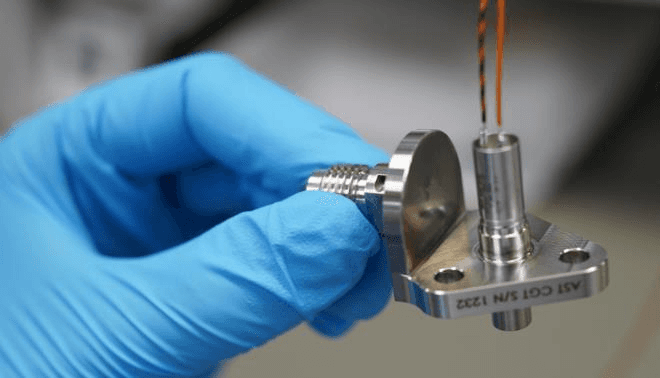
LP-CGT Characteristics
Operating media: He, N2, Xe, Kr (N2 with flight heritage). Inlet pressure MEOP 1 to 6 bar (typical 1-2 bar regulated); proof pressure 1.5× MEOP (verified during acceptance tests); burst pressure 4× MEOP (design value > 24 bar). Thrust up to 34 mN per bar of inlet pressure, proportional to inlet pressure with a wide range of thrust levels available. Minimum impulse bit 110 µNs (heritage at 1 bar, N2). Specific impulse > 69 s with N2 heritage, > 25 s qualified with Xe. Internal leakage < 1×10⁻⁵ sccs GHe and external leakage < 1×10⁻⁸ sccs GHe, both verified during acceptance tests. Thermal range -35°C to +95°C non-operational (including qualification margin) and -10°C to +80°C operational (full performance, gas dependent), with -20°C to +80°C for cold start (limited performance, heater recommended). Fluid filtration rate 11µm (5µm mesh at inlet). Mass under 60 g without harness or pipework. Average power consumption under 1 W at hold voltage, depending on valve actuation frequency. Valve operating voltage 22V to 32V (minimum pull-in voltage required for motorization margin, 50% hold-voltage). Vibration qualification levels exceed 30 gRMS on all three axes, and radiation tolerance exceeds 480 krad TID.
HP-CGT Characteristics
Operating media: N2, Ar, Kr, Xe, with characterization tests performed. Inlet pressure MEOP 186 bar for use with Xenon, 300 bar for use with Krypton or Argon; proof pressure 1.5× MEOP (verified during acceptance tests); burst pressure 2.5× MEOP (design value > 465 bar). Thrust up to 4 N, proportional to inlet pressure with a wide range of thrust levels available. Minimum valve actuation time 10 ms typical. Specific impulse > 65 s (N2), > 50 s (Ar), > 35 s (Kr), > 25 s (Xe), depending on inlet pressure and gas temperature. Internal leakage < 1×10⁻⁵ sccs GHe and external leakage < 1×10⁻⁸ sccs GHe, both verified during acceptance tests. Thermal range -10°C to +80°C non-operational (including qualification margin) and +25°C to +65°C operational (full performance for use with Xe), with -10°C to +65°C for cold start (limited performance, heater recommended). Fluid filtration rate 11µm (5µm mesh at inlet). Mass under 150 g without harness. Average power consumption under 3 W at hold voltage, depending on valve actuation frequency. Valve operating voltage 24V to 32V (minimum pull-in voltage required for motorization margin, 50% hold-voltage). Vibration qualification levels exceed 30 gRMS on all three axes, and radiation tolerance is 30 Mrad TID.
Paper No.
Published
2024
Conference
Authors
AST Advanced Space Technologies GmbH
Keywords
cold gas thruster, blow-down mode, attitude control, detumbling, orbit control, xenon, nitrogen, krypton, argon