Product Design Concepts
IEPC-2022-583
Building Blocks for EP Propellant Management Systems
37th International Electric Propulsion Conference · Massachusetts Institute of Technology, Cambridge, MA, USA · 19–23 June 2022
Hans-Peter Harmann, Marcel Berger
2022
Propellant Management
Electric Propulsion
Building Blocks
Abstract
AST presents a set of pre-qualified modular building blocks for electric propulsion propellant management systems, enabling rapid and cost-effective system design from LEO constellations to complex planetary missions.
Since 2011, AST Advanced Space Technologies GmbH develops components and technologies for propellant management systems for electric propulsion. The portfolio comprises pressure sensors, valves, filters, fill and drain valves, and more, built with a technology called the flow path board (FPB): components are placed onto the FPB like electronics components on a PCB, so the technology is called fluid-SMD. In recent years AST further improved the technology by introducing pre-qualified, standardized components and building blocks, allowing more complex systems to be designed with low risk and short development times, and increasing the number of identical parts for highly efficient manufacturing and sourcing.
II. Standardized Components
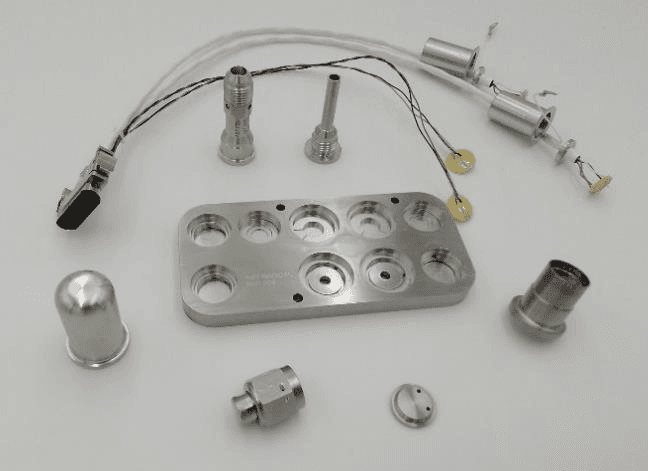
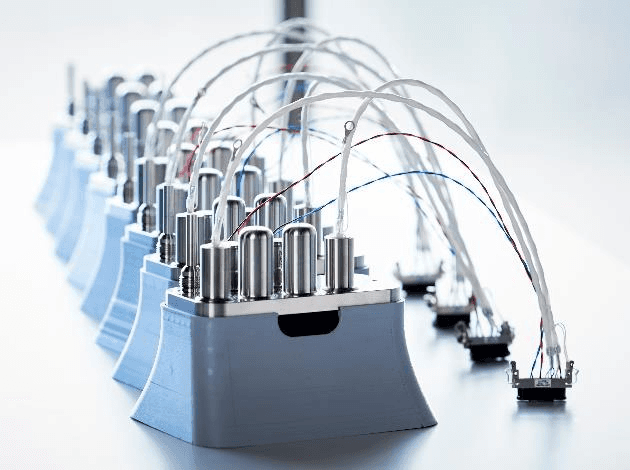
The lowest level of building blocks are standardized components together with their manufacturing and system assembly processes. The Flow Path Board acts as structural baseplate and interconnection layer, containing a 3D network of flow channels so that no tubes between components are required; flow restrictors can be integrated directly into the FPB using small-dimension channels. Channels start and end at ports, where components are placed and electron-beam welded for a robust, leak-tight joint.
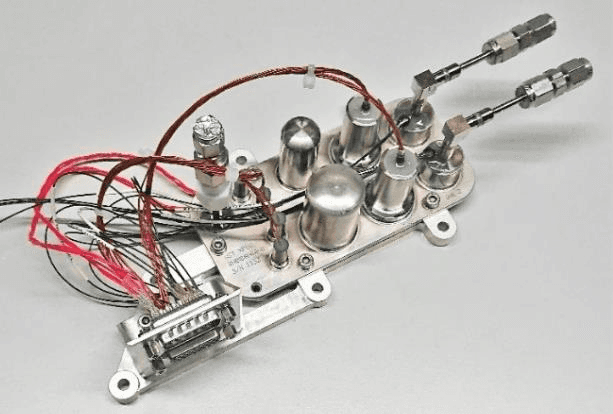
Other components placed into the FPB ports and welded include: inlet/outlet tube stubs (interconnecting spacecraft pipework with the FPB, equipped with a 5µm filter mesh at 11µm filtration rate); high-pressure/low-pressure valves (for propellant isolation or massflow/pressure control); high-/low-pressure sensors (for pressure measurement as input to closed-loop control); an intermediate plenum (allowing intermediate expansion to reduce pressure or flatten pressure ripples); a harness (interconnecting valves and sensor heads to spacecraft electrical infrastructure); and a fill-and-drain valve. Several subtypes exist per component category – e.g. pressure sensors in 1, 4, 50, 200 and 300 bar full-range variants – and fluidic interfaces can be straight tube for swaging or welding, AN-style fittings, or VCR. Direct welding to the stainless-steel FPB forms a robust interface with minimal mechanical coupling between components, so validation by similarity reduces the effort of mechanical, thermal and lifetime tests for new designs.
III. Common Building Blocks and Subsystems
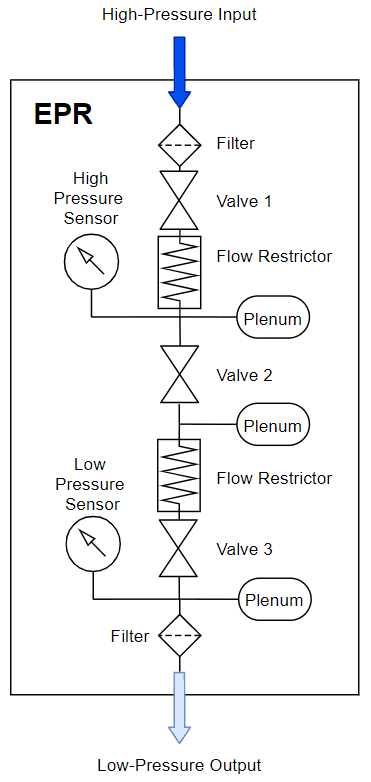
Manufacturing streamlining is a core target to reduce cost and production time. A standard FPB size with the footprint of a smartphone has been chosen, providing ports for up to 10 components per side (20 total), enough to master the complexity of most propellant management systems. The Electronic Pressure Regulator (EPR) building block, in its minimum configuration, consists of one FPB, two valves, one low-pressure sensor, two volumes and two fluidic connectors, operated in a bang-bang principle: a first valve takes a short pulse of gas from the tank through a restrictor to an intermediate volume, and a second valve expands the gas via a flow restrictor to the outlet volume, monitored by a pressure sensor that triggers recharging as needed. A third valve can be added in the inlet for triple-barrier isolation, and a high-pressure sensor can be integrated for full tank-monitoring functionality. Typical EPR performance: operating media GN2/GXe/GKr, operating pressure 5 to 300 bar, outlet pressure 1 to 5 bar, internal leakage < 10⁻⁵ sccs GHe, external leakage < 10⁻⁸ sccs GHe, max flow rates > 250 mg/s coarse / > 50 mg/s fine mode, pressure ripple < 20 mbar (fine mode), proof/burst pressure 1.5/2.5× MEOP, mass 0.65 kg, operating temperature range -20°C to +65°C.
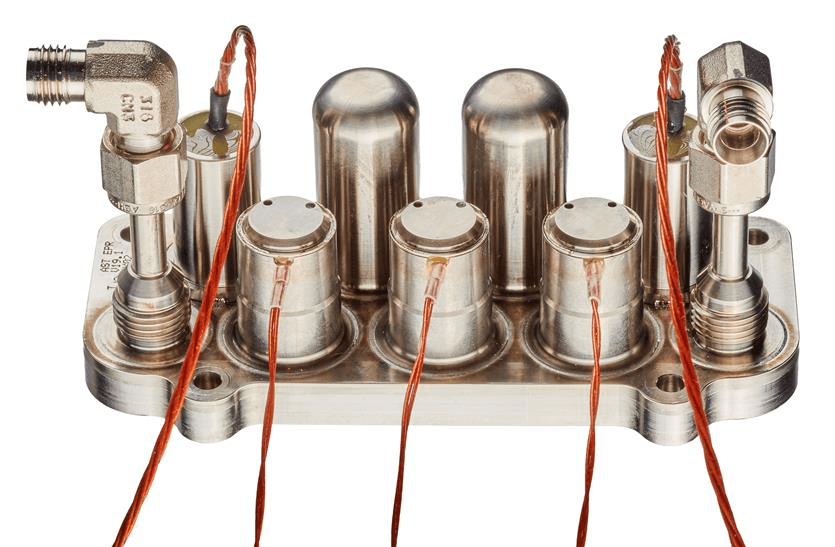
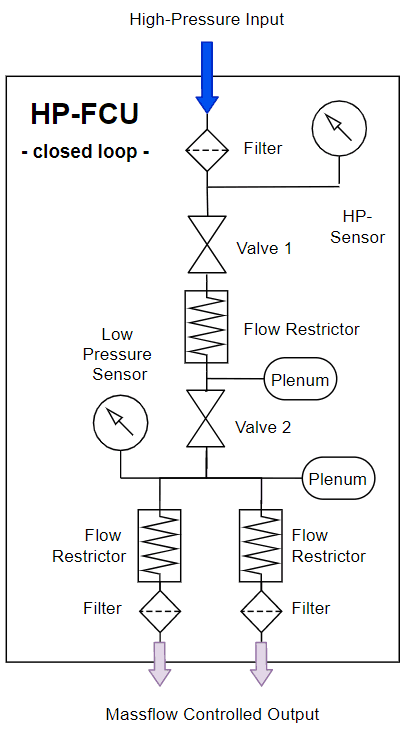
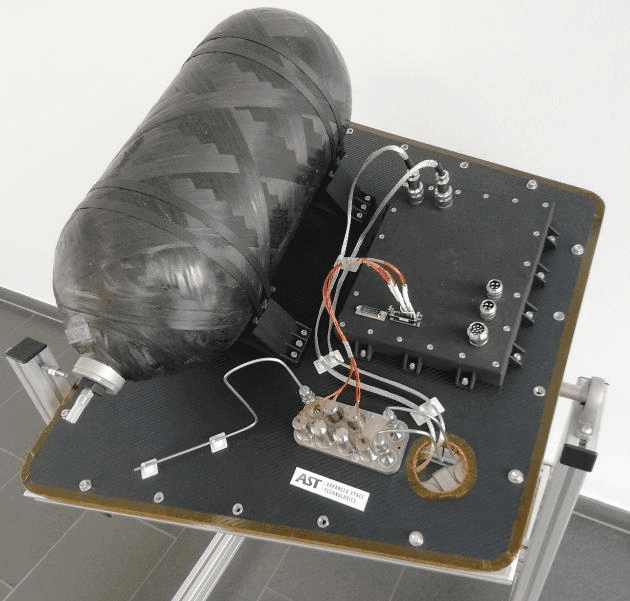
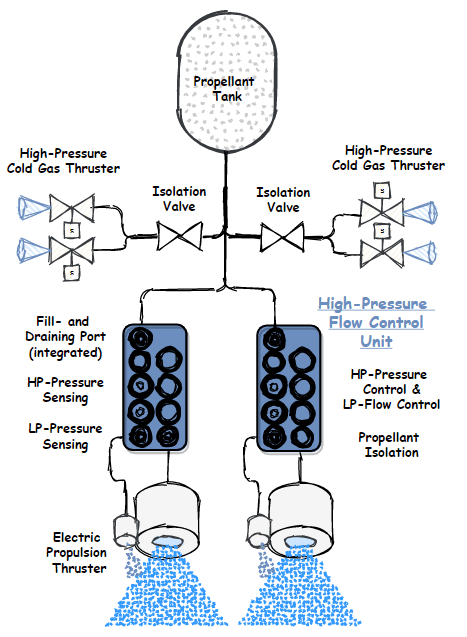
The High Pressure Flow Control Unit (HP-FCU) is directly derived from the EPR, using the same components and core design but splitting the outlet flow line into two lines with flow restrictors, transforming the internally controlled pressure into flow. The HP-FCU can directly supply a thruster anode and cathode from the tank without additional components, and has been used as the Xenon Feed System for the OneWeb constellation. Typical performance: operating media GXe/GKr, operating pressure 2 to 300 bar (150 bar for Xe), back-pressure selectable 0.3-0.8 bar, flow rates selectable e.g. 1.5 mg/s, flow split ratio selectable (typically 10/1 anode-cathode), flow ripple < 1%, proof/burst pressure 1.5/4× MEOP, mass < 0.9 kg.
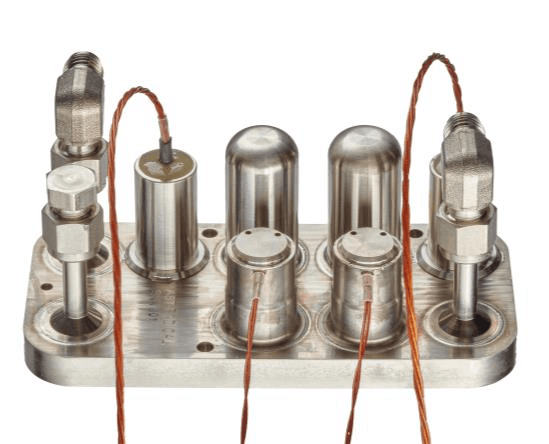
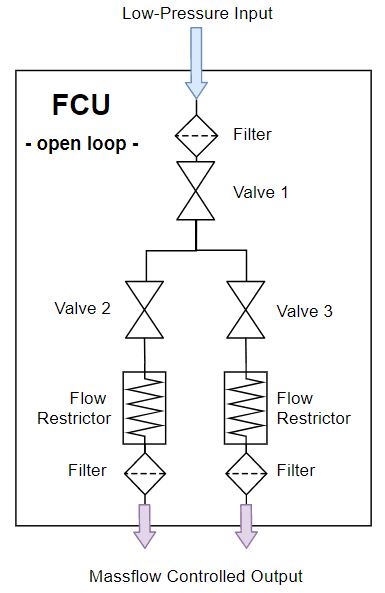
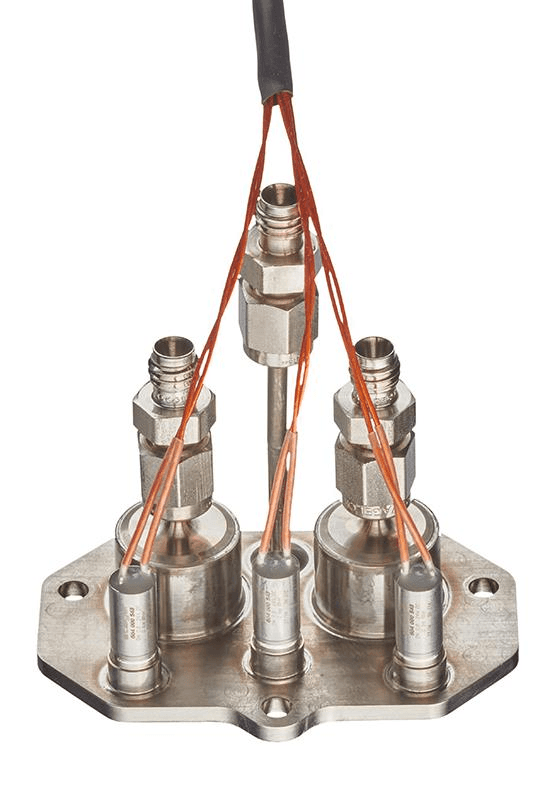
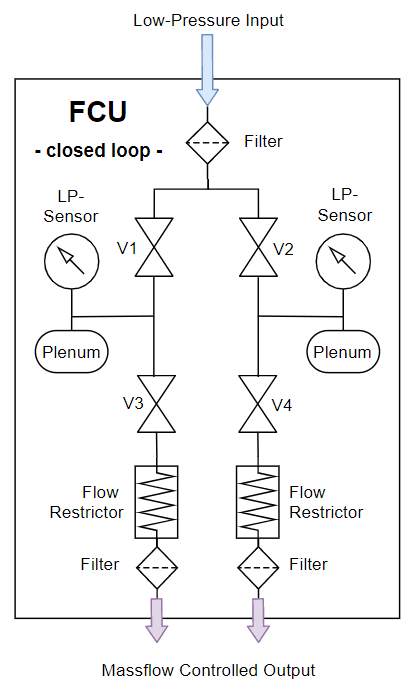
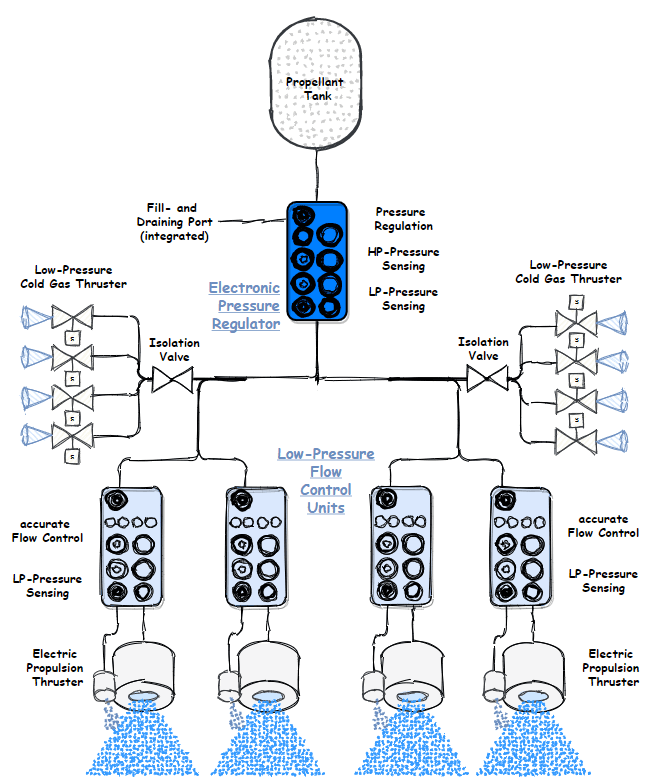
The Low Pressure Flow Control Unit (LP-FCU) is used with an EPR for complex EP systems with several thrusters. Its design concept mirrors the HPFCU: a flat FPB populated with surface-mounted valves, volumes, sensors and connections, giving a very low external leak rate. In the simplest, smallest configuration, only three low-pressure valves, the FPB, tube stubs and harness are used with no pressure sensors, relying on a thruster feedback parameter (e.g. anode current) as an “open loop” device; a closed-loop variant with integrated pressure sensors is also offered for systems without a useful thruster feedback signal. Typical performance: operating pressure 2 bar (0.5-8 bar), back-pressure selectable 0.3-0.8 bar, flow rates selectable e.g. 0.15-10 mg/s, flow ripple < 1%, mass < 0.07 kg (open-loop) / < 0.70 kg (closed-loop).
IV. Complex Systems
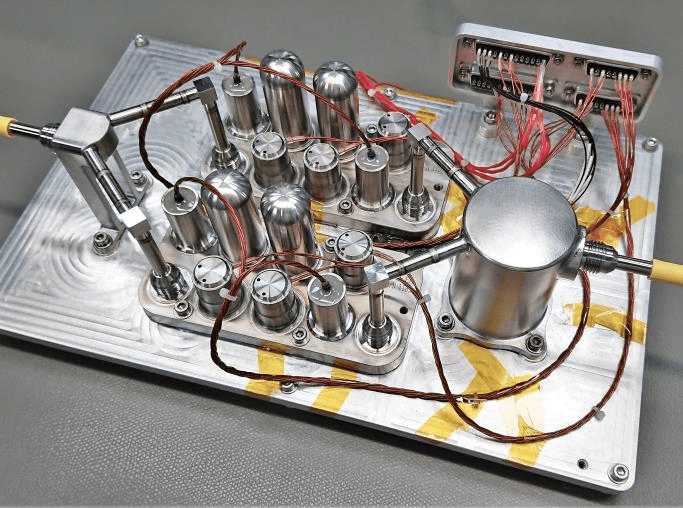
For more complex systems, multiple building blocks can be joined, complemented by stand-alone valves, sensors and cold gas thrusters. As one example, the pressure reduction and regulation system for the Mars Sample Return – Earth Return Orbiter mission (MSR-ERO) uses two identical EPR building blocks sharing one line to the tank, feeding into a low-pressure volume to eliminate ripple and damp transients, resulting in a compact, fully redundant system capable of twice the nominal flow rate when both branches operate in parallel. Other examples show an EP system for orbit raise using cold gas thrusters for detumbling and safe-mode, and a classic multi-thruster EP system combining one EPR block with several LP-FCU blocks and an optional low-pressure cold gas thruster branch.
V. Advantages of Building Blocks
Beside the obvious technical advantages of low mass, low volume and reduced AIT work, the building-block approach brings major non-technical advantages: standardization allows on-stock component availability instead of long-lead items; fast development cycles; reduced or eliminated non-recurring cost; continuity in production with reduced obsolescence risk; scaling effects for larger quantities of standard components; reduced recurring cost; and larger quantities enabling statistical methods for quality improvement.
VI. Current Usage of AST Building Blocks
AST’s propellant management systems and building blocks are currently used in several projects and programs. The largest heritage is with the OneWeb constellation: AST has delivered more than 650 Xenon Feed Systems based on the HPFCU design, of which 428 units had been launched and operated at the time of this paper, with accumulated in-orbit time exceeding 4.3 million hours. Other building blocks are used on satellites in GEO and LEO, and for deep space applications a complex system using EPR and LPFCU blocks is currently under development for MSR-ERO.
I. Introduction
I. Introduction
Since 2011, AST Advanced Space Technologies GmbH develops components and technologies for propellant management systems for electric propulsion. The portfolio comprises pressure sensors, valves, filters, fill and drain valves, and more, built with a technology called the flow path board (FPB): components are placed onto the FPB like electronics components on a PCB, so the technology is called fluid-SMD. In recent years AST further improved the technology by introducing pre-qualified, standardized components and building blocks, allowing more complex systems to be designed with low risk and short development times, and increasing the number of identical parts for highly efficient manufacturing and sourcing.
II. Standardized Components
The lowest level of building blocks are standardized components together with their manufacturing and system assembly processes. The Flow Path Board acts as structural baseplate and interconnection layer, containing a 3D network of flow channels so that no tubes between components are required; flow restrictors can be integrated directly into the FPB using small-dimension channels. Channels start and end at ports, where components are placed and electron-beam welded for a robust, leak-tight joint.
Other components placed into the FPB ports and welded include: inlet/outlet tube stubs (interconnecting spacecraft pipework with the FPB, equipped with a 5µm filter mesh at 11µm filtration rate); high-pressure/low-pressure valves (for propellant isolation or massflow/pressure control); high-/low-pressure sensors (for pressure measurement as input to closed-loop control); an intermediate plenum (allowing intermediate expansion to reduce pressure or flatten pressure ripples); a harness (interconnecting valves and sensor heads to spacecraft electrical infrastructure); and a fill-and-drain valve. Several subtypes exist per component category – e.g. pressure sensors in 1, 4, 50, 200 and 300 bar full-range variants – and fluidic interfaces can be straight tube for swaging or welding, AN-style fittings, or VCR. Direct welding to the stainless-steel FPB forms a robust interface with minimal mechanical coupling between components, so validation by similarity reduces the effort of mechanical, thermal and lifetime tests for new designs.
III. Common Building Blocks and Subsystems
Manufacturing streamlining is a core target to reduce cost and production time. A standard FPB size with the footprint of a smartphone has been chosen, providing ports for up to 10 components per side (20 total), enough to master the complexity of most propellant management systems. The Electronic Pressure Regulator (EPR) building block, in its minimum configuration, consists of one FPB, two valves, one low-pressure sensor, two volumes and two fluidic connectors, operated in a bang-bang principle: a first valve takes a short pulse of gas from the tank through a restrictor to an intermediate volume, and a second valve expands the gas via a flow restrictor to the outlet volume, monitored by a pressure sensor that triggers recharging as needed. A third valve can be added in the inlet for triple-barrier isolation, and a high-pressure sensor can be integrated for full tank-monitoring functionality. Typical EPR performance: operating media GN2/GXe/GKr, operating pressure 5 to 300 bar, outlet pressure 1 to 5 bar, internal leakage < 10⁻⁵ sccs GHe, external leakage < 10⁻⁸ sccs GHe, max flow rates > 250 mg/s coarse / > 50 mg/s fine mode, pressure ripple < 20 mbar (fine mode), proof/burst pressure 1.5/2.5× MEOP, mass 0.65 kg, operating temperature range -20°C to +65°C.
The High Pressure Flow Control Unit (HP-FCU) is directly derived from the EPR, using the same components and core design but splitting the outlet flow line into two lines with flow restrictors, transforming the internally controlled pressure into flow. The HP-FCU can directly supply a thruster anode and cathode from the tank without additional components, and has been used as the Xenon Feed System for the OneWeb constellation. Typical performance: operating media GXe/GKr, operating pressure 2 to 300 bar (150 bar for Xe), back-pressure selectable 0.3-0.8 bar, flow rates selectable e.g. 1.5 mg/s, flow split ratio selectable (typically 10/1 anode-cathode), flow ripple < 1%, proof/burst pressure 1.5/4× MEOP, mass < 0.9 kg.
The Low Pressure Flow Control Unit (LP-FCU) is used with an EPR for complex EP systems with several thrusters. Its design concept mirrors the HPFCU: a flat FPB populated with surface-mounted valves, volumes, sensors and connections, giving a very low external leak rate. In the simplest, smallest configuration, only three low-pressure valves, the FPB, tube stubs and harness are used with no pressure sensors, relying on a thruster feedback parameter (e.g. anode current) as an “open loop” device; a closed-loop variant with integrated pressure sensors is also offered for systems without a useful thruster feedback signal. Typical performance: operating pressure 2 bar (0.5-8 bar), back-pressure selectable 0.3-0.8 bar, flow rates selectable e.g. 0.15-10 mg/s, flow ripple < 1%, mass < 0.07 kg (open-loop) / < 0.70 kg (closed-loop).
IV. Complex Systems
For more complex systems, multiple building blocks can be joined, complemented by stand-alone valves, sensors and cold gas thrusters. As one example, the pressure reduction and regulation system for the Mars Sample Return – Earth Return Orbiter mission (MSR-ERO) uses two identical EPR building blocks sharing one line to the tank, feeding into a low-pressure volume to eliminate ripple and damp transients, resulting in a compact, fully redundant system capable of twice the nominal flow rate when both branches operate in parallel. Other examples show an EP system for orbit raise using cold gas thrusters for detumbling and safe-mode, and a classic multi-thruster EP system combining one EPR block with several LP-FCU blocks and an optional low-pressure cold gas thruster branch.
V. Advantages of Building Blocks
Beside the obvious technical advantages of low mass, low volume and reduced AIT work, the building-block approach brings major non-technical advantages: standardization allows on-stock component availability instead of long-lead items; fast development cycles; reduced or eliminated non-recurring cost; continuity in production with reduced obsolescence risk; scaling effects for larger quantities of standard components; reduced recurring cost; and larger quantities enabling statistical methods for quality improvement.
VI. Current Usage of AST Building Blocks
AST’s propellant management systems and building blocks are currently used in several projects and programs. The largest heritage is with the OneWeb constellation: AST has delivered more than 650 Xenon Feed Systems based on the HPFCU design, of which 428 units had been launched and operated at the time of this paper, with accumulated in-orbit time exceeding 4.3 million hours. Other building blocks are used on satellites in GEO and LEO, and for deep space applications a complex system using EPR and LPFCU blocks is currently under development for MSR-ERO.
Paper No.
IEPC-2022-583
Published
2022
Conference
37th International Electric Propulsion Conference · Massachusetts Institute of Technology, Cambridge, MA, USA · 19–23 June 2022
Authors
Hans-Peter Harmann, Marcel Berger
Keywords
propellant management, building blocks, flow control unit, electric propulsion, flow path board, fluid-SMD, MSR-ERO