Technology
SP2022_321
Behaviour of Pressure Sensors under the Influence of Ionizing and Non-Ionizing Radiation
Space Propulsion 2022 · Estoril, Portugal · 9–13 May 2022
Kyra Bekaan, Heiko Dartsch, Anastasios Stomas, Hans-Peter Harmann
2022
Pressure Sensors
Radiation Testing
Space Environment
Abstract
AST investigated the effects of ionizing and non-ionizing radiation on its pressure sensor cells, developing a predictive drift model as a function of radiation dose for accurate long-term readings in high-radiation space environments.
1. Introduction
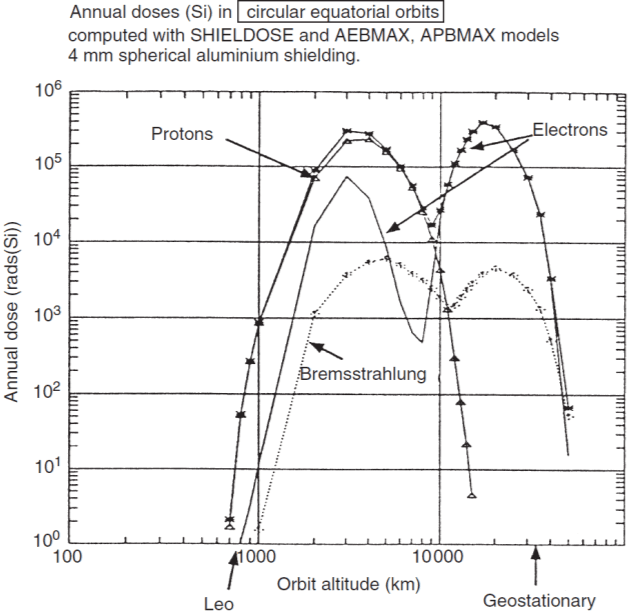
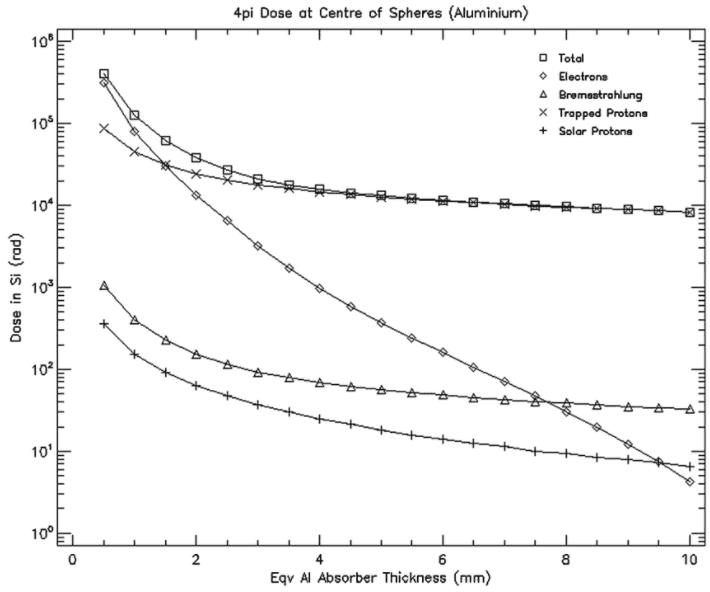
In any space mission – LEO, MEO, GEO or deep space – background radiation is a major factor that must be considered, since electrical components and sensors can suffer significant loss of accuracy from radiation exposure. Due to the Van Allen radiation belts, radiation is relatively high in certain regions, and doses of several hundred krad up to the Mrad range can be reached outside the spacecraft where shielding is minimal; for a typical 10-year LEO mission with AST’s products, a dose up to 40 krad can be assumed considering intrinsic shielding. The most radiation-sensitive components of AST’s products are the pressure sensors, and existing studies on their behaviour under radiation had relatively low resolution and were performed only at one pressure level. AST therefore conducted elaborate test campaigns investigating the influence of ionizing radiation (with pressure sensors regularly pressurized and continuously read out during exposure) and a similar test regarding non-ionizing radiation using neutrons.
2. Test Facilities
Irradiation took place at the Fraunhofer-Institut für Naturwissenschaftlich-Technische Trendanalysen (INT) in Euskirchen, Germany, using a ⁶⁰Co gamma source with a maximum dose rate of 720 krad/h, and a separate neutron source using THERMO-Fisher D-711 neutron generators producing fast neutrons via D-D or D-T fusion reactions with energies of 2.5 MeV and 14.1 MeV respectively.
3. Device Under Test
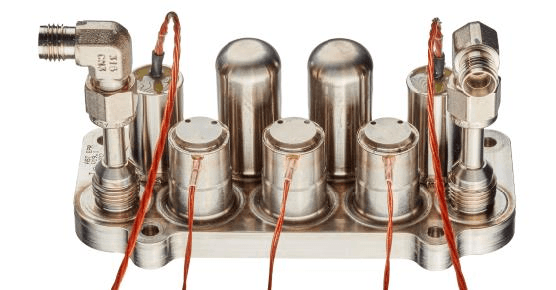
Two types of pressure sensors with full-range readings of 4 bar and 350 bar were tested, sharing the same design and technology and differing only in sensing-element sensitivity – the same types AST uses in its products. The passive bridge-type sensing elements contain no active electronics, so enhanced low dose rate sensitivity (ELDRS) does not need to be considered. The sensor circuit consists of a Wheatstone bridge plus additional fixed-value thick-film resistors used to reduce initial offset and temperature-dependent drift, individually determined by high-precision measurement during manufacturing; this resistor technology is known to be radiation-insensitive, confirmed by a dedicated test up to a TID of 40 Mrad.
4. Test Description
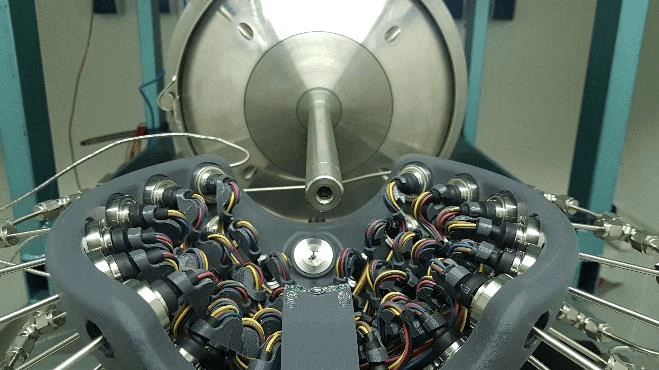
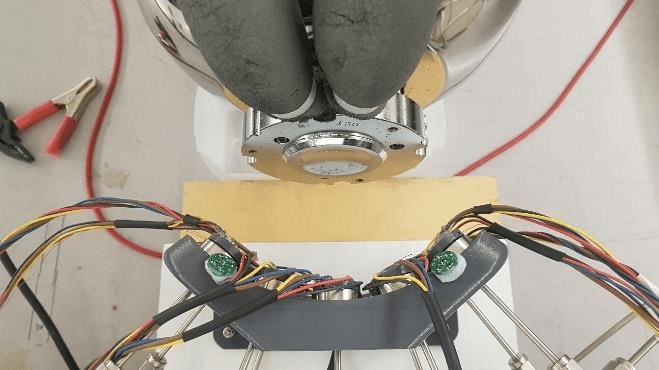
Throughout testing, sensors were operated continuously with nominal current, electrically connected and fluidically pressurized cyclically to different levels during irradiation, distinguishing between 4 bar and 350 bar sensor cells for high temporal resolution over the complete dose. Intrinsic stainless-steel housing shielding was assumed to give a worst-case attenuation of 80% for gamma radiation. Voltage and current were measured in situ to calculate bridge resistances R1-R4 and derive the sensor output signal, which shows a highly linear relation to pressure describable by y = m·x+b; a pre-irradiation zero-line period was recorded for each test as reference, with the 350 bar sensor’s percentage deviations calculated against an assumed 180 bar full-scale value reflecting AST’s typical applications.
5. Tests with Ionizing Radiation
Two irradiation runs were performed: a first test to a TID of 8 Mrad with 42 sensors, and a second, lower-dose-rate, higher-temporal-resolution test to a TID of 240 krad with 9 sensors, since typical TID values for AST’s products (5-50 krad) fall closer to this range. In the first test, none of the 42 sensors failed or showed unexpected behaviour. Data analysis showed the four installed bridge resistors changing value with increasing radiation dose due to physical changes in the sensing element, with each resistor of each sensor showing a consistent sensitivity and offset trend though differing slightly between sensors.
For the second test’s 4 bar sensor, individual resistances increased about 1.7% over the full 240 krad dose, with a saturation effect more pronounced early in irradiation; the derived sensitivity increased with a similar saturation effect while offset decreased slightly. For the 350 bar sensor, behaviour was similar in sensitivity trend but with a significantly higher maximum resistance change of about 2.4% (versus 1.7% for the 4 bar sensor), with the relative change of the two sensor types being similar up to about 25 krad before saturation started later for the 350 bar sensor; at 240 krad the sensitivity changed by more than 2.5%, with offset increasing nearly linearly before a plateau from 230 krad.
6. Radiation Hardening
The saturation effect observed in the first 8 Mrad test suggested it might be possible to “harden” sensors against radiation-induced effects by pre-exposing them to a certain dose. Three sensors already exposed to 8 Mrad in the first test were reused in the second 240 krad test. Results showed the individual resistances of a pre-irradiated 4 bar sensor only increasing by about 0.2% over the complete 240 krad dose – about 12% of the change without pre-irradiation – and for the 350 bar sensor the change was reduced to about 0.2% (about 8% of the original value) despite the larger initial 2.4% change. Sensitivity of pre-irradiated 4 bar sensors changed by only about 0.15% versus 1.4% for non-pre-irradiated sensors (one tenth), and pre-irradiated 350 bar sensors changed only about 0.3% versus 2.7% (a reduction of almost 90%). The effect on offset differed: non-pre-irradiated 4 bar sensors drifted negatively (max -0.12% FS) while pre-irradiated sensors drifted positively (max +0.15% FS), giving approximately the same absolute offset error in both cases; the smaller offset change for non-pre-irradiated 350 bar sensors (0.04%) could still be halved to about 0.02% by pre-irradiation.
7. Tests with Non-Ionizing Radiation
During neutron irradiation, a total non-ionizing dose of 1×10⁹ MeV/g(Si) was reached (equivalent to 2.6×10¹¹ neutrons at 14 MeV/cm²), covering typical applications of AST’s products, with no sensor failures observed over the entire test period. Resistance changes were partially reversible (unlike gamma irradiation): for the 4 bar sensor the change in resistance reached 0.13% during irradiation but decreased to below 0.025% afterward, and the 350 bar sensor reached 0.12% reducing to about 0.02% due to self-annealing after irradiation ended. Because a very high dose rate was used to apply the total dose in about 5 hours (instead of over years under real conditions), these values are regarded as worst-case estimates; sensitivity changes of about 0.06% (4 bar, dropping to about 0.02% after irradiation) and about 0.04% (350 bar, dropping to 0.01%) were observed, with offset changes remaining small and considered with caution due to noise.
8. Summary and Conclusion
Pressure sensors are sensitive to gamma radiation but withstand a very large dose (8 Mrad) without showing signs of failure, so the impact of radiation-induced effects on overall sensor reliability is negligible. Based on these measurements, AST now has an empirical model predicting end-of-life pressure-reading performance for any given mission environment, resulting in a maximum contribution to end-of-life error of < ±0.5% for the 4 bar sensor and < ±0.8% for the 350 bar sensor in a typical LEO mission. Sensitivity to gamma radiation can be reduced to about 1/10 by pre-irradiating sensors, while non-ionizing radiation produces only a small, largely self-annealing increase in sensitivity and offset, so the neutron test results can be taken as worst-case estimations.
Paper No.
SP2022_321
Published
2022
Conference
Space Propulsion 2022 · Estoril, Portugal · 9–13 May 2022
Authors
Kyra Bekaan, Heiko Dartsch, Anastasios Stomas, Hans-Peter Harmann
Keywords
pressure sensors, ionizing radiation, non-ionizing radiation, radiation hardening, total ionizing dose