Product Design Concepts
SP2022_308
Advances on Cost-Optimized High-Pressure Flow Control Unit within the HIPATIA Project
Space Propulsion 2022 · Estoril, Portugal · 9–13 May 2022
Sergey Gorbachev, Nils Hildebrand, Heiko Dartsch, Hans-Peter Harmann, Jaume Navarro, Victor Gomez, Mercedes Ruiz
2022
Flow Control
Helicon Plasma Thruster
HIPATIA
Abstract
Within the EU H2020 HIPATIA program, AST develops a cost-optimized propellant flow control unit for the Helicon Plasma Thruster, presenting flow characterization results and a building-block design for the engineering qualification model.
Space engineering is experiencing dynamic development, with an increased demand for small satellites due to reduced component frame size and huge satellite numbers for constellations. The trend towards electric propulsion drives a need for accurate but inexpensive propellant flow regulation. AST’s existing commercial product, the High-Pressure Flow Control Unit (HP-FCU), manufactured in serial production, combines electric pressure regulation and flow control in a single device that can feed any type of ion thruster (e.g. GIE, HEMPT, HET) plus its corresponding neutralizer with xenon or krypton, designed for large-scale manufacturing with a mass below 1 kg and the footprint of a cell phone. This paper outlines the technical goals and milestones of the HIPATIA (Helicon PlasmA Thruster for In-space Applications) development activity, an EU-funded H2020 program in cooperation with SENER, aimed at reducing complexity and cost of the unit based on AST’s flight-heritage HP-FCU design for use with the Helicon Plasma Thruster (HPT).

2. Propellant Management in HIPATIA Subsystem
The HIPATIA project aims to verify functionality and performance of an electric propulsion system based on HPT technology, which offers acceptable performance while eliminating the neutralizer line, electrodes and high-voltage electronics, driving costs down. The propulsion system consists of a Thruster Unit (TU), a Radiofrequency Generation and Power Unit, and the Propellant Flow Control Unit (PFCU), which provides the thruster unit with the required flow rate. Closed-loop PFCU operation based on thruster feedback is also being developed, potentially increasing specific impulse.
3. Development Plan
The HIPATIA project aims to advance the HPT’s development status to TRL 7 for the complete EP system. The propellant unit’s development logic starts with the PFCU elegant breadboard (EBB), based on HP-FCU technology, followed by test campaigns and design iterations leading to the PFCU Engineering Qualification Model (EQM), which consolidates test outcomes and raises TRL to 6.
4. AST’s High-Pressure Flow Control Unit
The PFCU design for HIPATIA is based on AST’s HP-FCU, with hundreds of customized units of this design currently operating in LEO. The basic HP-FCU model is a two-stage flow regulator that reduces tank gas pressure to a controlled pressure and translates it to a desired flow rate on the anode and cathode lines, using switching-valve flow-rate regulation with filters, a high-pressure sensor, a high-pressure valve, plena, a low-pressure valve, a low-pressure sensor and flow restrictors. It is designed for inlet pressures up to 300 bar (450 bar proof) and outlet pressures up to 50 bar, with typical internally controlled pressures between 0.5 and 4.5 bar.
5. PFCU Elegant Breadboard Model
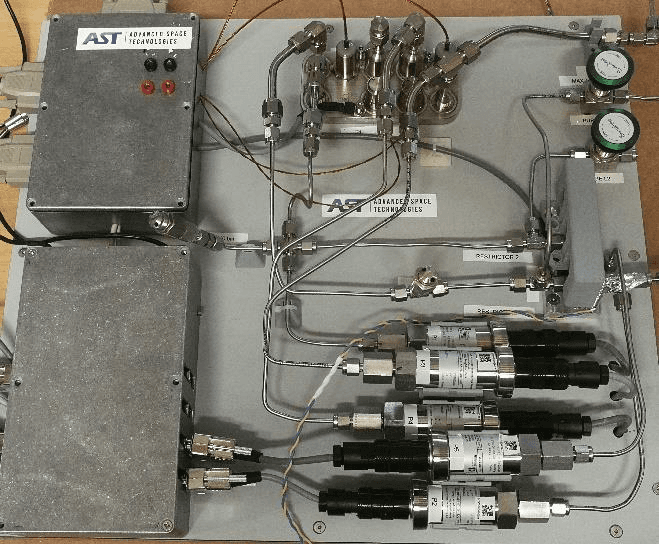
The main approach for the HIPATIA PFCU is to integrate the propellant control unit as deeply as possible into the EP subsystem while maintaining maximum flexibility and minimum manufacturing cost, simplifying the design since pressure sensors can be omitted for closed-loop thruster operation. Two identical EBBs were manufactured for parallel testing at UC3M in Madrid and at AST’s facilities in Germany, complemented by AST’s EGSE providing control during performance and coupling tests, with capability for both open-loop and closed-loop control.
6. PFCU EBB Test Results
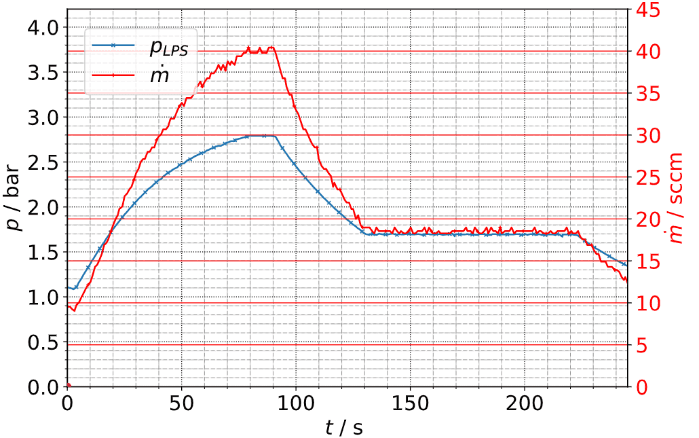
Test campaigns were conducted in 2021 at UC3M and AST facilities, successfully coupling the PFCU EBB with the RFGPU and thruster unit using krypton and xenon. Operation points for krypton were identified: ignition at 67 sccm, operation point 1 at 40 sccm, and operation point 2 at 20 sccm. Mass flow rate stabilization time between operation points was measured to enable closed-loop operation, e.g. transition time from ignition to OP1/OP1 to OP2 was under 37 seconds and ignition to OP2 under 58 seconds. The critical inlet pressure, at which mass flow drops more than 5% below nominal, corresponds to a ratio of 1.5 of inlet pressure to set pressure. Mass flow rate stability for krypton was confirmed to be within ≤ 0.3% for ignition phase and ≤ 0.5% for OP2. Coupling tests with the thruster unit were successfully conducted at UC3M, confirming that the PFCU EBB can operate with the TU and provide the desired mass flow rates and required accuracy.
7. PFCU EQM Approach
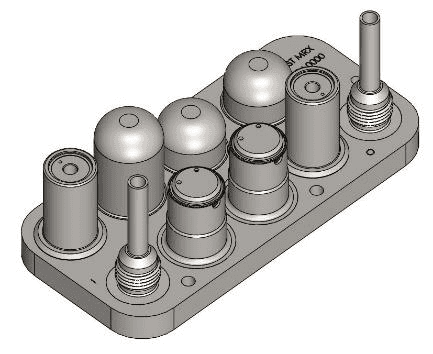
Based on the gathered test data, the Engineering Qualification Model (EQM) design matures for enhanced performance. While the EBB’s HP-FCU contains internal channels forming the baseplate and fluidic connections, the EQM is based on a more modular concept: the flow path board has a general internal design that can be equipped later with components matching the desired flow regime, using a stock of premanufactured FPBs and flow restrictors for fast adaptation without harming component qualification status.
8. PFCU EQM Design
Two EQMs are being manufactured for the current project phase: EQM1 equipped with sensors, and EQM2 relying on feedback signal from the thruster (voltage between 0 and 12V that actuates the low-pressure valve, tracked by the high-pressure valve) for a simplified closed-loop design omitting sensors.
9. Summary
Coupling tests were conducted with simultaneous operation of all HIPATIA units including the EBB PFCU. Additional transient-behaviour tests were carried out and performances evaluated, especially compatibility and flow characteristics for krypton, feeding into the EQM design.
10. Way Forward
Manufacturing activities of the PFCU EQMs are already running, with equipment and test facilities for the building-block concept being developed and tested. Coupling test campaigns with EQM models of all HIPATIA system units are expected in the second half of 2022, with a successful campaign expected to raise the whole system’s TRL to 7.
1. Introduction
1. Introduction
Space engineering is experiencing dynamic development, with an increased demand for small satellites due to reduced component frame size and huge satellite numbers for constellations. The trend towards electric propulsion drives a need for accurate but inexpensive propellant flow regulation. AST’s existing commercial product, the High-Pressure Flow Control Unit (HP-FCU), manufactured in serial production, combines electric pressure regulation and flow control in a single device that can feed any type of ion thruster (e.g. GIE, HEMPT, HET) plus its corresponding neutralizer with xenon or krypton, designed for large-scale manufacturing with a mass below 1 kg and the footprint of a cell phone. This paper outlines the technical goals and milestones of the HIPATIA (Helicon PlasmA Thruster for In-space Applications) development activity, an EU-funded H2020 program in cooperation with SENER, aimed at reducing complexity and cost of the unit based on AST’s flight-heritage HP-FCU design for use with the Helicon Plasma Thruster (HPT).
2. Propellant Management in HIPATIA Subsystem
The HIPATIA project aims to verify functionality and performance of an electric propulsion system based on HPT technology, which offers acceptable performance while eliminating the neutralizer line, electrodes and high-voltage electronics, driving costs down. The propulsion system consists of a Thruster Unit (TU), a Radiofrequency Generation and Power Unit, and the Propellant Flow Control Unit (PFCU), which provides the thruster unit with the required flow rate. Closed-loop PFCU operation based on thruster feedback is also being developed, potentially increasing specific impulse.
3. Development Plan
The HIPATIA project aims to advance the HPT’s development status to TRL 7 for the complete EP system. The propellant unit’s development logic starts with the PFCU elegant breadboard (EBB), based on HP-FCU technology, followed by test campaigns and design iterations leading to the PFCU Engineering Qualification Model (EQM), which consolidates test outcomes and raises TRL to 6.
4. AST’s High-Pressure Flow Control Unit
The PFCU design for HIPATIA is based on AST’s HP-FCU, with hundreds of customized units of this design currently operating in LEO. The basic HP-FCU model is a two-stage flow regulator that reduces tank gas pressure to a controlled pressure and translates it to a desired flow rate on the anode and cathode lines, using switching-valve flow-rate regulation with filters, a high-pressure sensor, a high-pressure valve, plena, a low-pressure valve, a low-pressure sensor and flow restrictors. It is designed for inlet pressures up to 300 bar (450 bar proof) and outlet pressures up to 50 bar, with typical internally controlled pressures between 0.5 and 4.5 bar.
5. PFCU Elegant Breadboard Model
The main approach for the HIPATIA PFCU is to integrate the propellant control unit as deeply as possible into the EP subsystem while maintaining maximum flexibility and minimum manufacturing cost, simplifying the design since pressure sensors can be omitted for closed-loop thruster operation. Two identical EBBs were manufactured for parallel testing at UC3M in Madrid and at AST’s facilities in Germany, complemented by AST’s EGSE providing control during performance and coupling tests, with capability for both open-loop and closed-loop control.
6. PFCU EBB Test Results
Test campaigns were conducted in 2021 at UC3M and AST facilities, successfully coupling the PFCU EBB with the RFGPU and thruster unit using krypton and xenon. Operation points for krypton were identified: ignition at 67 sccm, operation point 1 at 40 sccm, and operation point 2 at 20 sccm. Mass flow rate stabilization time between operation points was measured to enable closed-loop operation, e.g. transition time from ignition to OP1/OP1 to OP2 was under 37 seconds and ignition to OP2 under 58 seconds. The critical inlet pressure, at which mass flow drops more than 5% below nominal, corresponds to a ratio of 1.5 of inlet pressure to set pressure. Mass flow rate stability for krypton was confirmed to be within ≤ 0.3% for ignition phase and ≤ 0.5% for OP2. Coupling tests with the thruster unit were successfully conducted at UC3M, confirming that the PFCU EBB can operate with the TU and provide the desired mass flow rates and required accuracy.
7. PFCU EQM Approach
Based on the gathered test data, the Engineering Qualification Model (EQM) design matures for enhanced performance. While the EBB’s HP-FCU contains internal channels forming the baseplate and fluidic connections, the EQM is based on a more modular concept: the flow path board has a general internal design that can be equipped later with components matching the desired flow regime, using a stock of premanufactured FPBs and flow restrictors for fast adaptation without harming component qualification status.
8. PFCU EQM Design
Two EQMs are being manufactured for the current project phase: EQM1 equipped with sensors, and EQM2 relying on feedback signal from the thruster (voltage between 0 and 12V that actuates the low-pressure valve, tracked by the high-pressure valve) for a simplified closed-loop design omitting sensors.
9. Summary
Coupling tests were conducted with simultaneous operation of all HIPATIA units including the EBB PFCU. Additional transient-behaviour tests were carried out and performances evaluated, especially compatibility and flow characteristics for krypton, feeding into the EQM design.
10. Way Forward
Manufacturing activities of the PFCU EQMs are already running, with equipment and test facilities for the building-block concept being developed and tested. Coupling test campaigns with EQM models of all HIPATIA system units are expected in the second half of 2022, with a successful campaign expected to raise the whole system’s TRL to 7.
Paper No.
SP2022_308
Published
2022
Conference
Space Propulsion 2022 · Estoril, Portugal · 9–13 May 2022
Authors
Sergey Gorbachev, Nils Hildebrand, Heiko Dartsch, Hans-Peter Harmann, Jaume Navarro, Victor Gomez, Mercedes Ruiz
Keywords
flow control unit, propellant management system, flow measurement, HP-FCU, electric propulsion, Helicon Plasma Thruster, HIPATIA