Product Designs and Development
SP2024_200
Achievements of a High-Pressure Cold Gas Thruster Development
Space Propulsion 2024 · Glasgow, Scotland · 20–23 May 2024
Jan-René Haferkamp, Marcel Berger, Davina Di Cara
2024
Cold Gas Thruster
High Pressure
Electric Propulsion
Abstract
AST developed a high-pressure cold gas thruster generating over 2 N of thrust across a 300 bar to 1.5 bar pressure range without a pressure regulator, serving as a high-thrust complement to existing electric propulsion systems.
1. Introduction
Modern satellite platforms rely on established electric propulsion systems for efficient propellant use, but these systems provide limited thrust – usually only a few hundred millinewtons – restricting their use to long-duration manoeuvres. High-thrust actuators are necessary for detumbling after launcher separation, collision avoidance, orbit insertion, or safe mode. AST Advanced Space Technologies GmbH has developed a high-pressure cold gas thruster (HP-CGT) capable of generating thrust exceeding 2 N using standard gases such as nitrogen, argon, krypton and xenon, operating efficiently from a maximum expected operating pressure of 300 bar down to an end-of-life pressure of 1.5 bar without requiring a pressure regulator. This thruster serves as a high-thrust extension to existing EP systems: an isolation valve connects the propellant tank of the main propulsion system to the HP-CGT branch, allowing shared propellant (e.g. xenon or krypton) without an additional tank, using a minimal number of additional components for high reliability, light weight and simple integration.

2. HP-CGT Design
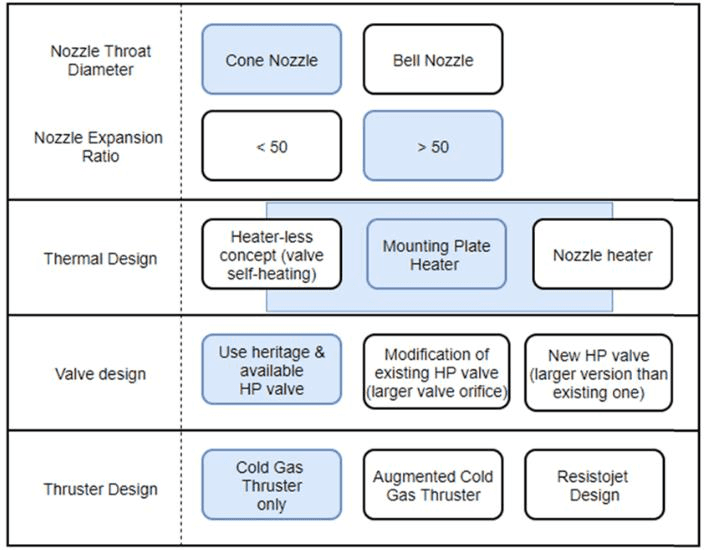
Key design requirements, defined by ESA and supplemented by AST, included thrust > 2 N at MEOP in steady-state operation with xenon, ISP > 25 s at MEOP and > 20 s at 5 bar (xenon), characterised pulsed-mode performance for short on-pulses (10 ms to 1000 ms) across operating pressures, and analysis-supported performance characterisation at intermediate operating points. Design trade-offs at component level (e.g. nozzle shape, valve design) weighed concepts such as resistojet, augmented CGT and pure CGT. Expertise from AST’s heritage products played a special role: the high-pressure valve from AST’s series products was reused, along with electron-beam welding manufacturing processes and design experience from the LP-CGT.
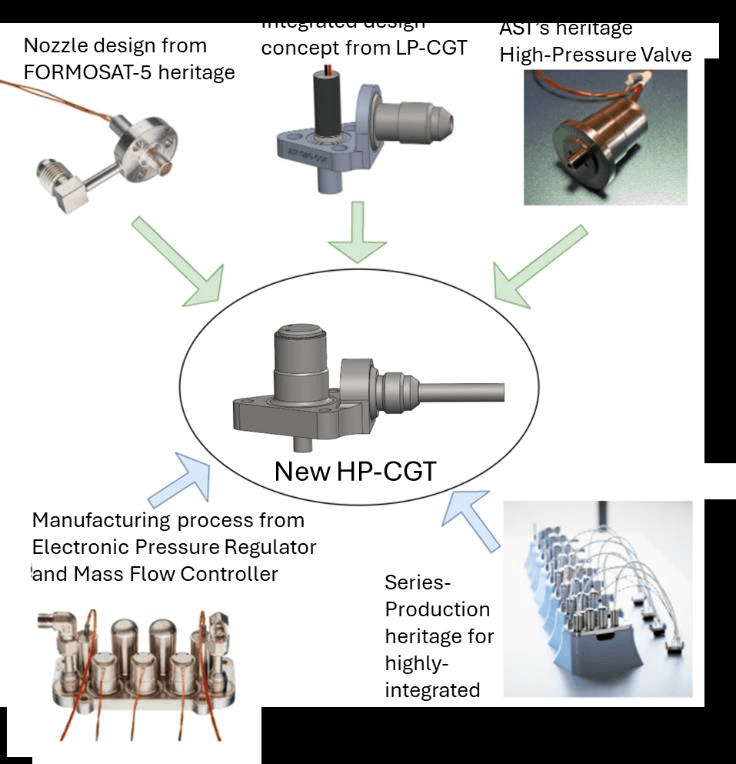
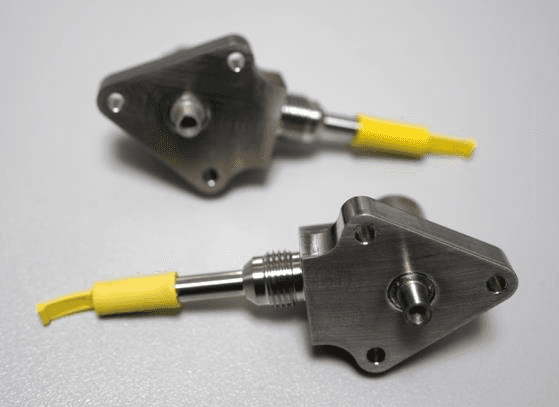
Two elegant breadboard (EBB) units were built in different configurations to compare the ratio of nozzle throat diameter to valve orifice diameter, since larger nozzle throats increase thrust but risk adversely affecting performance if too large relative to the valve orifice, and since Joule-Thompson cooling of the expanding propellant at high inlet pressures could damage the elastomer valve seal or cause clogging. A removable aluminium heating block was added as an option to reduce cooling impact. The final design used AST’s standard components and fluidic interfaces joined by electron-beam welds to the mounting plate.
3. HP-CGT Test Campaign
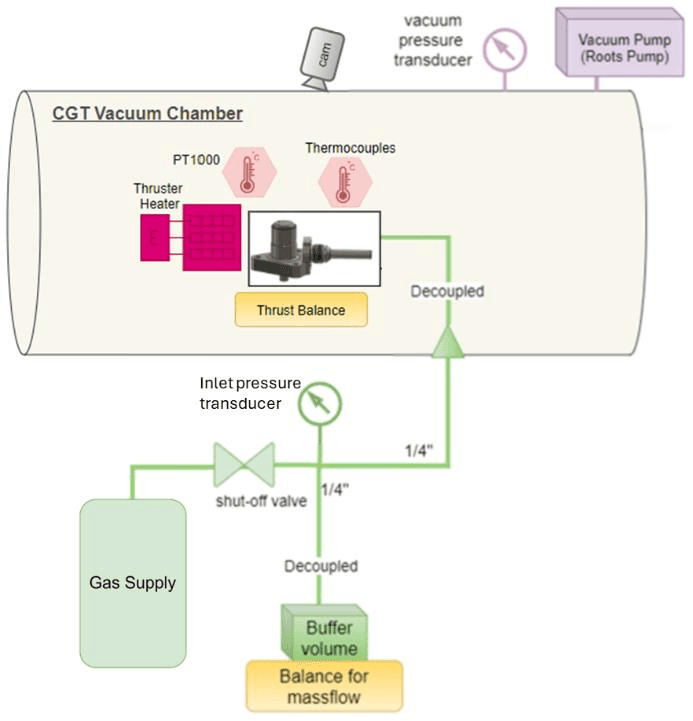
AST developed a unique high-pressure, high-flow test set-up with direct thrust measurement under vacuum, using a jig-mounted CGT on a high-precision industrial measuring scale inside a vacuum chamber, with dedicated test software recording temperature, pressure, mass flow and thrust data. Propellant was stored in a one-litre buffer volume, mounted on a separate measuring scale to determine propellant consumption per shot, with the propellant line mechanically decoupled by a loop in the pipe to minimise disturbance on the thrust scale. Three test types were performed: integrity tests (initial inspection, health checks, proof pressure); continuous firing mode (thruster fired continuously for a duration depending on inlet pressure, at room temperature or 60°C via a heating block); and minimum impulse bit (MIB) characterisation, using a reliable minimum valve-opening time of 10 ms, with several thousand rapid pulses run in succession to derive a time-averaged impulse bit since the thrust scale could not resolve individual pulses. Testing proceeded from nitrogen through argon and krypton to xenon, covering over 200 continuous firing tests and several thousand MIB cycles across both EBB configurations.

4. Test Results
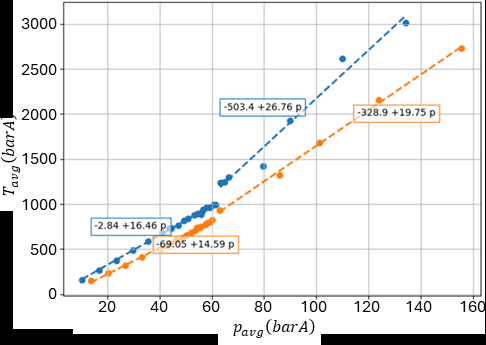
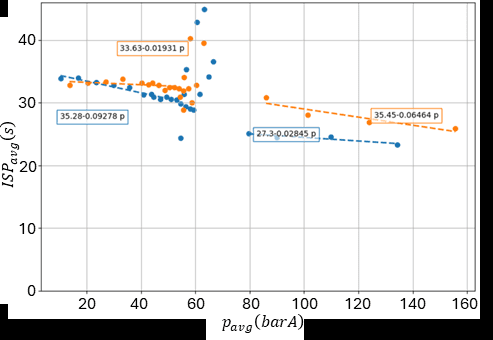
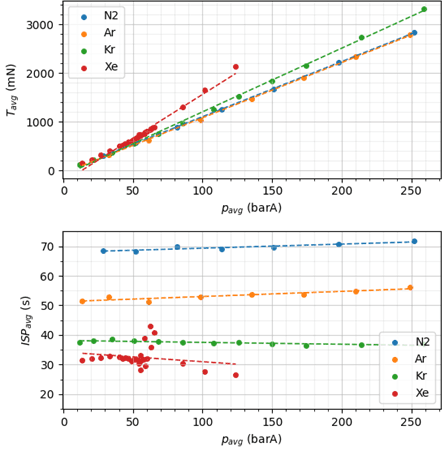
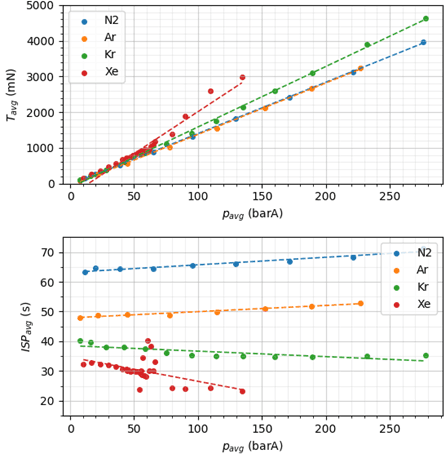
Among all propellants tested, xenon showed the most unique ISP/thrust-over-pressure characteristics: a higher ISP of 30-35 s in the gaseous phase up to 40 bar, versus around 25 s in the supercritical phase from 80 bar upwards, with irregular, history-dependent behaviour in the transition region between about 50 and 80 bar. Thrust appeared independent of temperature and linearly proportional to inlet pressure, while ISP was higher in the heated (60°C) state than unheated, and the CGT with the larger nozzle throat generated more thrust at the same pressure. Overall technical achievements: propellants tested N2, Ar, Kr, Xe; inlet pressure range 186 bar (Xe) / 300 bar (other gases) down to 3 bar; thrust up to 4 N, proportional to inlet pressure; ISP > 65 s (N2), > 50 s (Ar), > 35 s (Kr), > 25 s (Xe) depending on inlet pressure and gas temperature; size 93 x 43 x 44 mm with fluidic interface; mass < 150 g without harness; operational thermal range -10°C to +65°C (heritage valve range); minimum valve actuation time 10 ms.
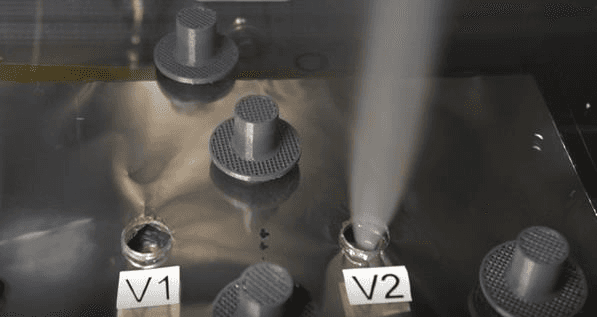
Videos of the xenon exhaust plume during firing showed the visible condensing plume constricting over time, with ice formation observed on the vacuum chamber viewport, attributed to xenon rather than water given the low background pressure and high-purity gas used. No clogging or non-steady mode was observed during firing, and final health checks revealed no unexpected degradation for either HP-CGT after the full test series, suggesting valve seals were not damaged by Joule-Thompson cooling.
5. Development and Qualification Plan
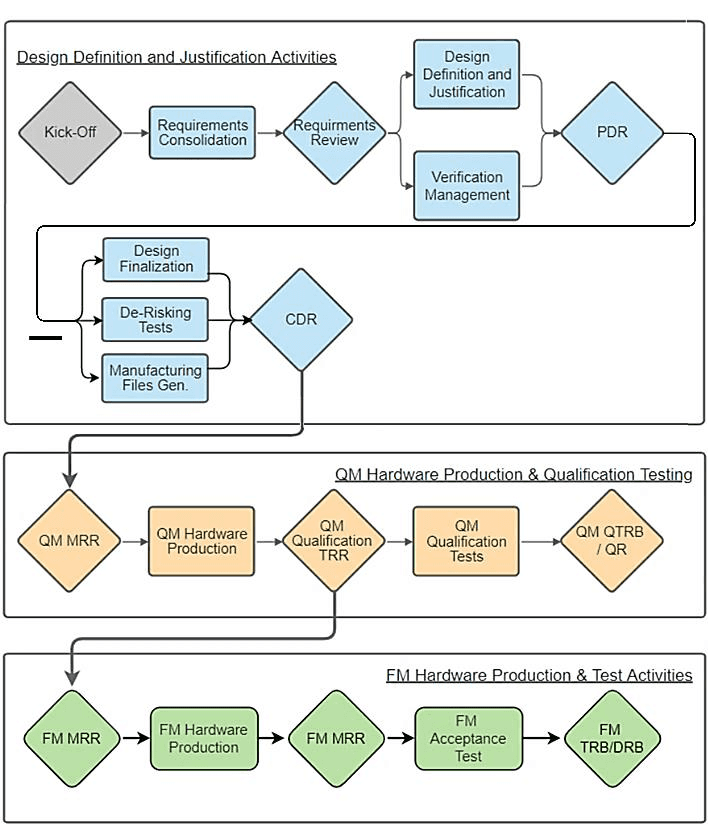
With positive characterisation results proving design suitability for future spacecraft, AST defined a preliminary Design, Development and Verification plan following ECSS standards, with details to be agreed with the spacecraft prime, estimating that the HP-CGT design could be finalized and brought to flight standard for a specific mission within 18 months.
6. Summary and Conclusion
The HP-CGT development activity started in March 2022, iterating ESA’s initial requirements with functional, performance, environmental and test requirements, then conducting design trade-offs and lower-level de-risking tests. Two EBBs in four total configurations were manufactured using AST’s heritage component design and flight-standard manufacturing processes, then subjected to extensive characterisation testing with new measurement and test procedures established for high mass flows at high pressures. The overall goal of exceeding 2 N thrust at relevant inlet pressure was realized with all tested gases, with short 10 ms operation times enabling small minimum impulse bits. A development and qualification plan was established, and no obstacles were found preventing finalisation of the design and qualification for AST-defined high-thrust actuators on upcoming gaseous-propulsion satellites.
Paper No.
SP2024_200
Published
2024
Conference
Space Propulsion 2024 · Glasgow, Scotland · 20–23 May 2024
Authors
Jan-René Haferkamp, Marcel Berger, Davina Di Cara
Keywords
high pressure, cold gas thruster, collision avoidance, safe mode, detumbling, xenon propellant, krypton and argon propellant